A new piece of research out of Italy could see a big change to classification of the UK's rarest reptile. Scientists from the OPHIS Paleontological Museum and Herpetological Centre in Teramo, Italy, have published a study on the smooth snake (Coronella austriaca) suggesting it could now be seen as a venomous snake.
Published in the journal Zootaxa, researchers studied five specimens from three onotogentic stages and determined that the rear fangs of smooth snakes are actually covered with sheaths that are in turn connected to the venom-producing Duvernoy’s gland. This suggests that the smooth snake, in common with other species in the family Colubridae, is able to deliver venom to aid the digestion of prey.
Although the smooth snake (Coronella austriaca) is widespread across Eurasia, the UK population is largely confined to the sandy heathland of Hampshire, Dorset and Surrey. Unlike the two other snake species native to the British Isles, the adder (Viper berus) and grass snake (Natrix helvetica), the smooth snake rarely basks in direct sunlight, preferring instead to regulate its blood temperature through direct contact with its surroundings.
Smooth snakes spend much of their life underground and are slim bodied with keel-less scales (from which they gain their common name) with an olive-brown to red colouring and 2 rows of faint, dark spots running down the flanks.
They have a crown pattern on the top of the head (from which they were given their Latin name ‘coronella’) and rounded, ‘teddy-bear’ eyes. They are small snakes, very rarely exceeding 80cm in length, but can be the dominant snake species in the heathland habitats in which they thrive.
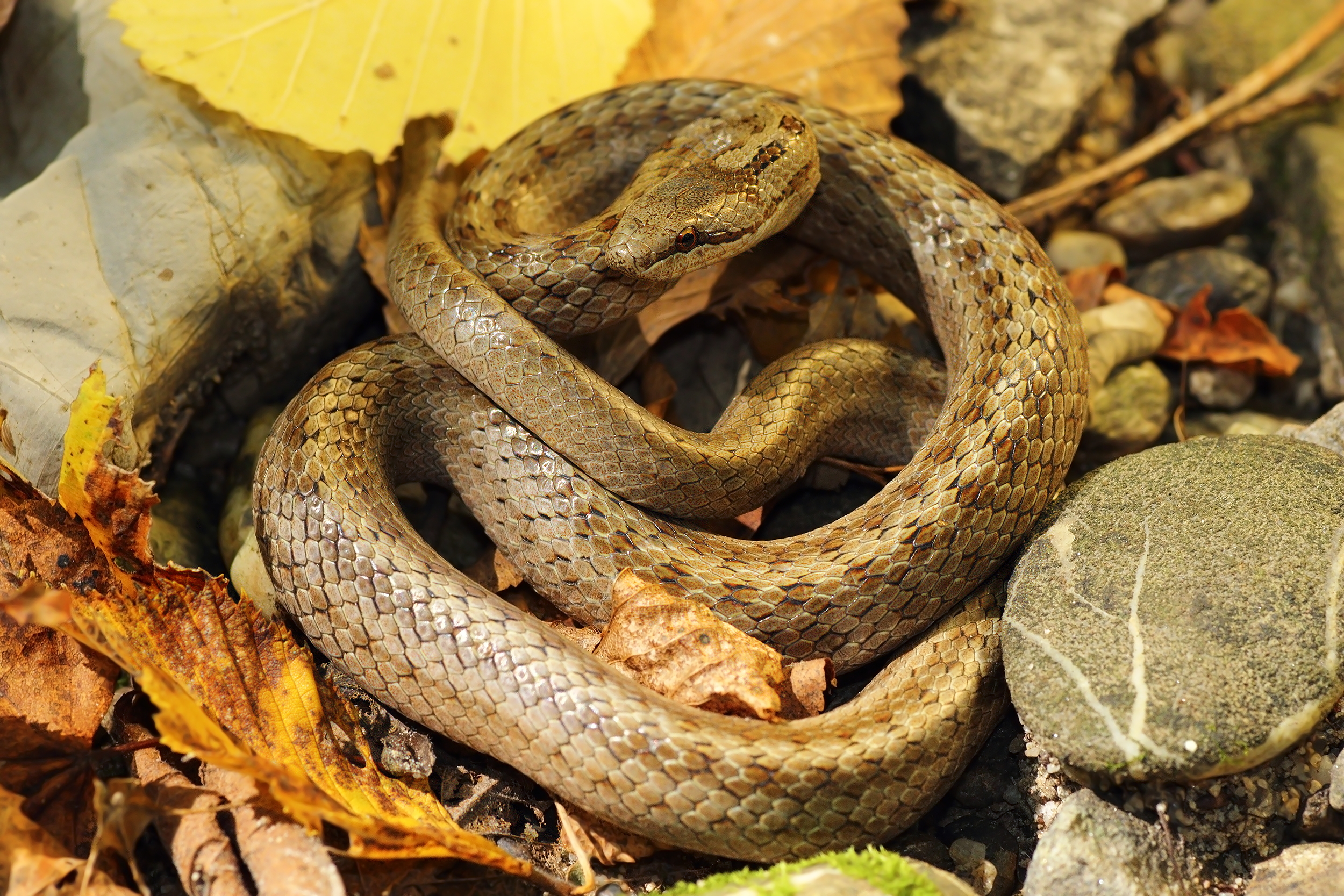
This is due in part to their diet, which comprises lizards and juvenile snakes, alongside small mammals. They are constrictors, subduing prey within the coils in their bodies, but will then deliver venom through mastication, a process of which one of the authors of the paper has personal experience.
In 2012, Alessandro Paterna was bitten by a smooth snake while carrying out fieldwork in the Laga Mountains. Smooth snakes will often bite when handled, although wounds are usually superficial, with just occasional light bleeding.
On this occasion, however, the bite was prolonged and Paterna observed the snake ‘masticating’, making slow, grinding movements of the jaw. Paterna subsequently experienced itchiness and reddening from the area where the rear fangs contacted the skin, although the effects subsided within an hour.
“It is important for us to clarify,” Paterna and Meier write in conclusion, “that except for the inevitable reclassification of this snake, we recommend not changing the consideration we have always had of this species, which, given its nature and size, represents absolutely no threat to humans.”