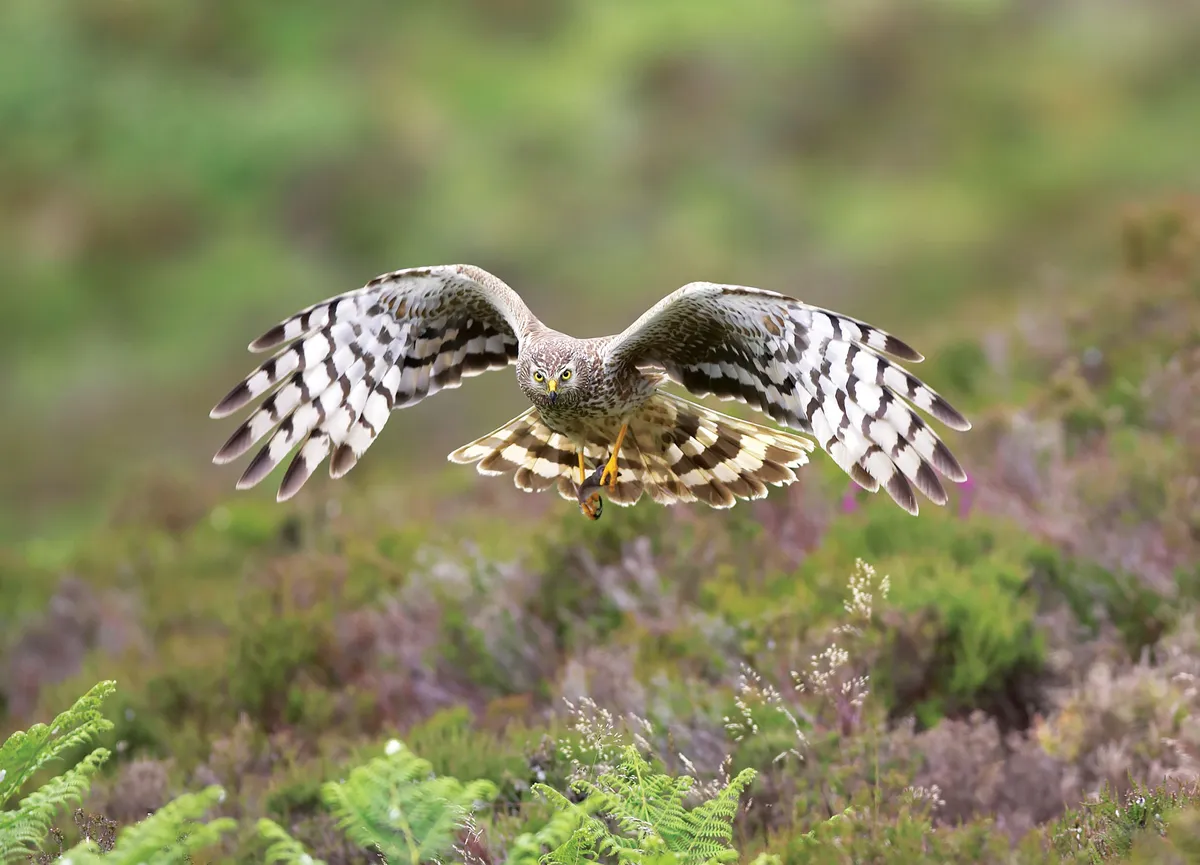
They may be small in stature, but Britain’s tiniest birds of prey are formidable hunters. From hovering kestrels to lightning-fast merlins, these five micro raptors prove that size is no barrier to speed, skill and survival.
- What's the most common bird of prey in the UK?
- "At speeds in excess of 200mph it will power down, headfirst, into the wing of its prey" – 12 deadliest birds of prey in the UK
Britain's smallest birds of prey
Kestrel

Common kestrels are one of the UK’s most widespread and most easily seen birds of prey. One of the falcon family, they are distributed throughout large parts of the country and often seen hovering over roadside verges.
They are highly recognisable as they are the only UK raptor species that hovers for long periods, literally hanging in the air with their head motionless, watching. Other birds of prey such as marsh harriers and short-eared owls will occasionally hover for a brief period, particularly if it’s windy, but none will employ this hunting technique so consistently as the kestrel. It is such a characteristic feature of the bird that countryfolk in years gone by referred to them as windhovers.
Kestrels are just a little bit bigger than a feral pigeon, and in their search for voles and other small mammals the birds have a preference for open grassland or heaths, although it’s not unknown to spot one sweeping down on an unsuspecting mouse in a town park.
Their eyesight is their secret weapon. It is not only extremely sharp – 12 times better than a human’s – so that it can home in on the slightest movement of foliage caused by a foraging rodent, but it can also see UV light. This is a huge asset as it enables the bird to track the progress of its prey through long grass thanks to the trail of UV-rich urine it leaves behind.
Sparrowhawk

Compact but deadly is a good description of a sparrowhawk. These small to medium-sized birds of prey are ambush specialists. They have short, rounded wings and a long, narrow tail that enable them to manoeuvre skilfully around trees, switch direction unexpectedly and skip suddenly over hedgerows to surprise and pounce on smaller birds.
Female sparrowhawks are as much as 25% bigger than males so they can catch birds up to the size of pigeons, whereas the males confine themselves to blackbird size or smaller. Their diet of songbirds has made them unpopular in people’s gardens as they stake out feeders in anticipation of an easy meal.
But considering the number of small farmland birds they take, compared to the numbers that have been lost thanks to diminishing habitats and huge reductions in their insect food, they should have no discernible impact on a healthy ecosystem.
Sparrowhawk numbers crashed during the 1950s and 60s, mainly due to poisoning in their food chain from now-banned pesticides such as DDT. Their numbers have since been increasing throughout the UK except in the Scottish Highlands, but they remain with an Amber status on the list of birds of conservation concern.
Hobby

The hobby is another bird of the falcon family, like the kestrel. They are the second smallest bird of prey in the UK when they visit in the summer, migrating from their over-winter homes in Africa.
Their wings are noticeably long and narrow, relative to their small size, and their bodies are streamlined. These features make them extremely fast in flight and very agile. In fact, they are some of the fastest birds in Britain, which is just as well – they have to be speedy to catch their flying invertebrate prey, particularly dragonflies.
Though they breed across much of the UK, hobbys are most common in Wales and on moorlands in England. Their distinctive sickle-shaped wings aid identification when they are seen swooping low and fast over a lake or along the edges of a woodland in search of insects. When they catch one, they will pass it from talons to beak in mid-air, rather than waste time landing to eat.
Little Owl

This tiny member of the owl family weighs less than a small tin of beans. They’re not much larger than a thrush, but their distinctive flat-topped head, large, forward-facing eyes and chunky oval shape makes them unmistakably an owl. Little owls were introduced to the UK from warmer parts of Europe in the 19th century, with about 40 being released between 1874 and 1880.
- Guide to Britain's owl species: where to see and common species found in the UK
- What's the most common owl in the UK?
From then their numbers slowly increased across England, but they are not generally found in the southwest, Scotland, Northern Ireland or central Wales. Lately, however, numbers have been dropping slightly, according to the British Trust for Ornithology’s Breeding Bird Survey.
Unlike other owl species, little owls can often be seen in daylight, perched in trees or sitting on fenceposts or rocks. They not only eat small mammals and birds up to their own bodyweight, but also beetles, small reptiles and worms. These are feisty little birds that maintain territories aggressively and if a stranger approaches a male’s domain it will be seen off immediately with angry swoops and bared claws.
Merlin

Now we come to the smallest British bird of prey, and that is not its only claim to fame. The merlin is also the smallest falcon to be found in the Northern Hemisphere. They are present in the UK all year round, but their populations swell in winter due to migrants arriving from Iceland.
In the breeding season merlins live primarily in the uplands of Wales, Scotland, Northern Ireland and southwest and northern England, particularly the Peak District. In winter they spread out to lowland farmland and coastal marshes.
A merlin is scarcely bigger than a blackbird but it preys on even smaller birds such as meadow pipits, and it’s also an efficient hunter of mammals such as fieldmice and voles. It’s capable of killing prey considerably heavier than itself which it finds by skimming close to the ground. It can be recognised by its rapid wingbeats mixed with occasional glides during which its wings are held tight to the body.
In the 19th century the birds were often chosen by ladies for falconry, particularly to hunt larks. In modern times, loss of habitat has put them on the UK Red List as a bird of conservation concern.