
This family of fish is so bizarre it might have swum straight out of a fairy tale. There are three species of lamprey in British waters and while they share similar characteristics, such as the jawless mouths and long eel-like form, each has a uniqueness unchanged for millions of years.
The largest of the three, the sea lamprey is over a metre long and 2kg in weight. It has a mottled appearance, with dark brown-green splotches on a paler, pastel background, which becomes orange as it readies for breeding. The skin has no scales but is covered in a cuticle that acts as a protective barrier. Lamprey lack paired fins, but the sea lamprey has two dorsal fins positioned towards the tail, edged with a small caudal fin.
Along each side of the head is a line of seven branchial openings, behind which are the gill filaments. Most fish draw water through the mouth and out through the gill flaps, but these holes enable the lamprey to receive oxygen without using its mouth, vital to the way in which the lamprey feeds, and a reason why it is sometimes called the ‘vampire fish’.
The mouth is underslung, rounded and fearsome in look. Circles of small sharp teeth surround a funnel-like throat, enabling the lamprey to attach to another fish like a sucker as its teeth and tongue rasp at the flesh. During this, the lamprey secretes proteins from its buccal glands that act as anticoagulant, so the parasite can feed upon the blood of its host.
The host may die as a direct result of this parasitisation, or as inflicted wounds become infected. Humans, however, can rest easy. Should a lamprey latch onto an unsuspecting swimmer, it will likely detach itself, having detected warm blood.
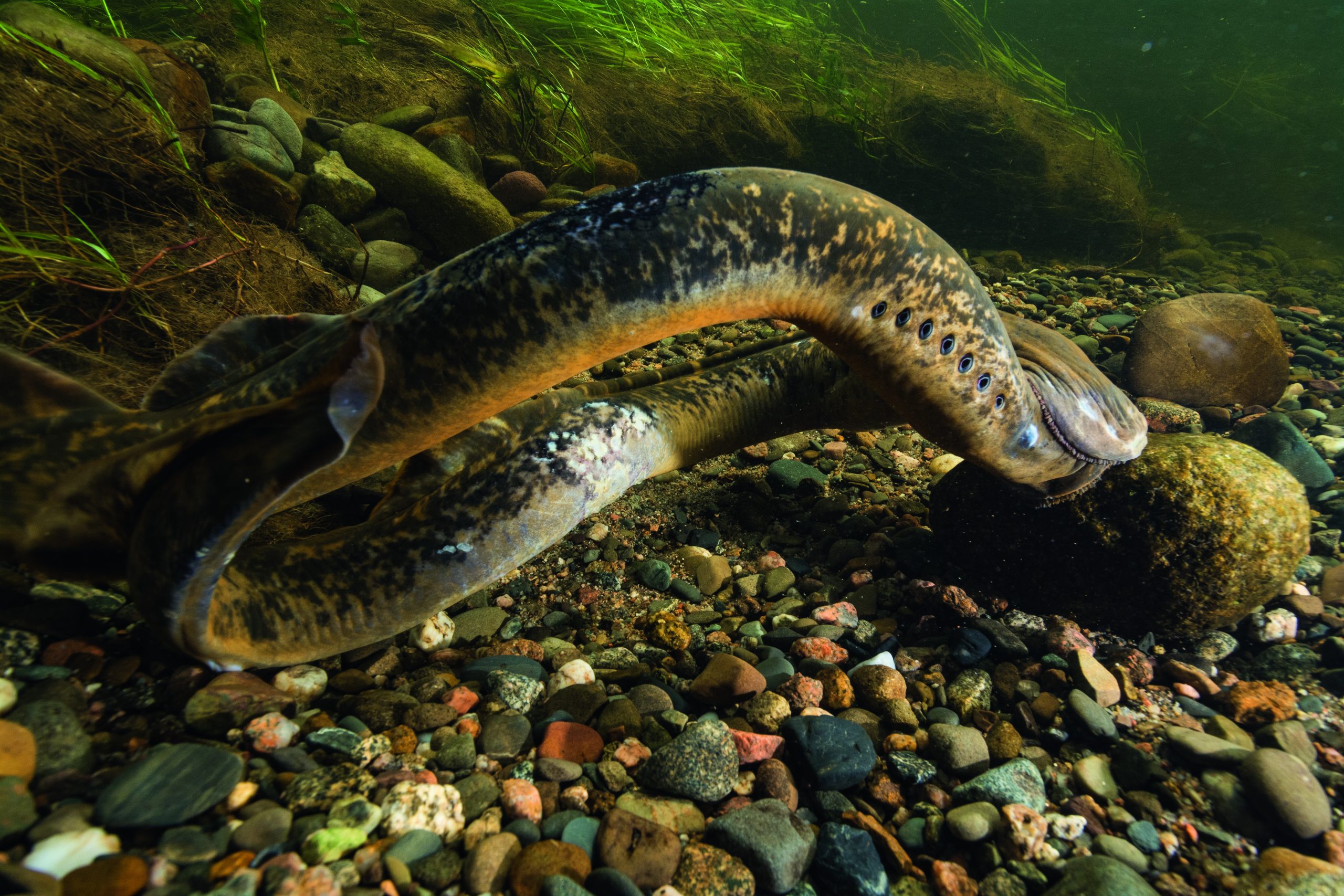
River lamprey, sea lamprey, and brook lamprey
Despite their name, river lamprey spend a similar amount of time as the sea lamprey in a marine environment. Both species are anadromous; they spend much of their adult life at sea but return to freshwater to breed. The larvae spend several years in the soft sediments where they hatch before maturing and migrating to the sea, where they remain for a further two or three years.
At between 25cm and 40cm as adults, river lamprey are far smaller than the sea lamprey. In the freshwater of Loch Lomond, a group of river lamprey has evolved to maintain a life cycle; they are smaller than their migratory counterparts.
The smallest of the three species, the brook lamprey spends its entire life in freshwater and most of it in a larval state, only developing into adult form to breed. The adults, around 15cm long, do not feed but use their mouthparts to move small stones to create redds (gravel nests) into which thousands of eggs are deposited. They live for only a few months in this phase.
Words by Kevin Parr
Top image: Sea lamprey (Petromyzon marinus) mouth portrait, Great Lakes Aquarium, Minnesota.
