
The Neolithic period was a time of great human advancement, with hunter-gatherer lifestyles being abandoned for the new technology of agriculture.
During this time, huge stone structures were also built across Britain and Ireland. And while we still don't have all the answers of just how and why they were built, they have attracted the attention of archeologists and history-lovers alike for centuries.
- Hundreds of mysterious burial tombs were built across the English countryside 1,000 years before the Pyramids of Giza – why?
- Best stone circle sites to visit in the UK
Best neolithic structures in Britain and Ireland
Wayland’s Smithy, Oxfordshire

Ringed by lofty beech trees and standing alongside the ancient Ridgeway National Trail above the Vale of White Horse near the village of Ashbury, this impressive stone-chambered long barrow is over 5,400 years old – and it sits on top of an even older burial site.
When it was first excavated in 1963, the remains of 14 people – 11 men, two women and a child – were found in the earlier structure, as well as fragments of pottery and arrowheads. Radiocarbon dating showed that the first burials were placed there between 3590 and 3555 BCE. The second, larger barrow with its monumental façade was built sometime between 3460 and 3400 BCE.
The mound was once believed to be the home of Wayland the Smith – or Weland, as the Anglo-Saxons knew him (inspired by Völundr from Norse and Germanic legend) – a metalworker with supernatural powers.
Legend has it that if a passing traveller’s steed needs a new horseshoe, they could leave their mount at the long barrow overnight with a coin; in the morning, the horse would be shod and the money gone.
Today, this ancient place has an eerie, peaceful atmosphere redolent of ages past. The famous chalk Uffington White Horse is etched into the turf just 1.5 miles to the north-east on Whitehorse Hill, below an outstanding example of a large Iron Age hillfort that offers far-reaching views across several counties.
Castlerigg Stone Circle, Cumbria
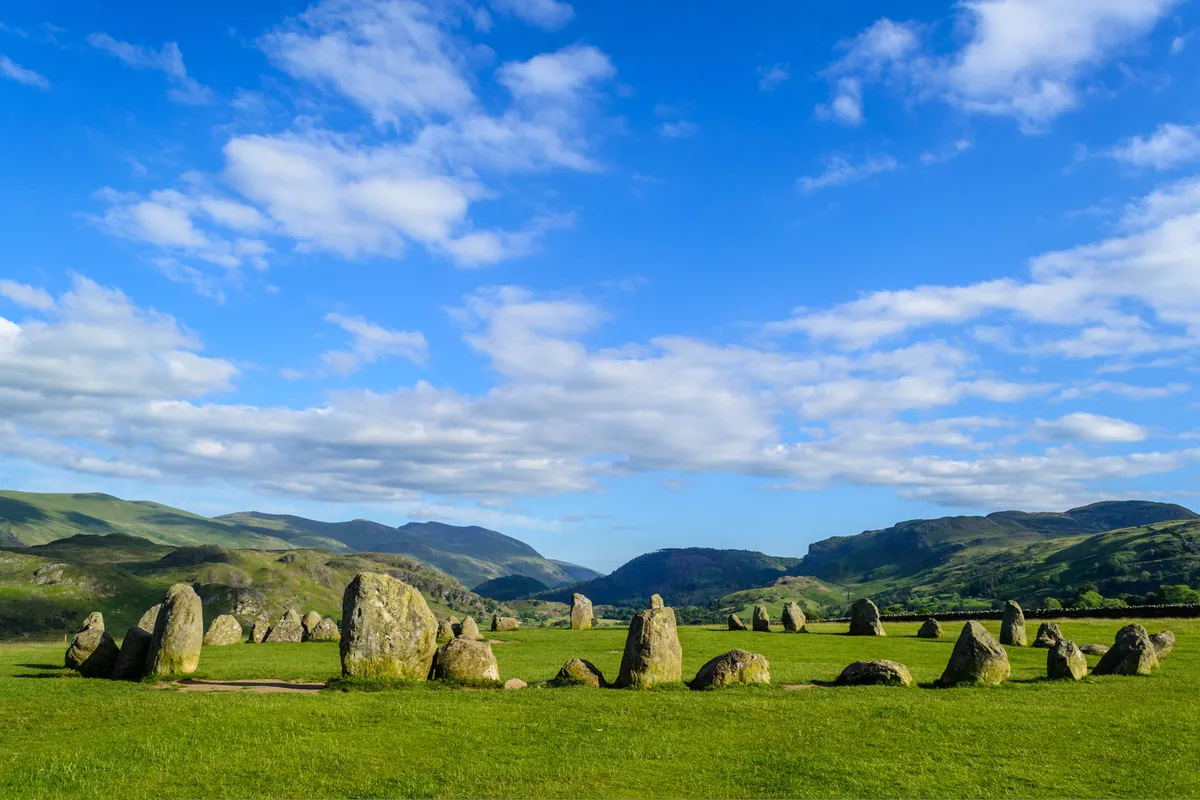
Overlooking beautiful Thirlmere Valley in the Lake District, this English Heritage site enjoys a theatrical scenic backdrop, with the mountains of Helvellyn and High Seat towering in the distance and 360° vistas of the surrounding fells.
Among the earliest such sites in Britain, raised around 3000 BCE, Castlerigg comprises 38 hefty standing stones – some up to 3m tall – in a circle some 30m in diameter.
Though the precise function of early circles is not known, it probably served as a meeting point for scattered Neolithic communities, perhaps providing a space for ritual, social or trade activities, or as
a tool for astronomical observations.
The mystery surrounding this site only adds to its appeal – who were the circle makers and why did they place these stones here? Many visitors feel an ancient energy alive in the air; local poets say that it “crackles”.
There’s space for a few cars to park near the site, or you can walk to it from Keswick on a circular four-mile loop partly following a path along a disused railway line.
Pentre Ifan, Pembrokeshire

This dramatic cromlech has a five metre-long capstone, weighing around 17 tonnes, that rests on three uprights, with three other stones standing nearby. Here, you can drink in distant views of the Irish Sea, the Preseli Hills, Carn Ingli and Meibion Owen (Owen’s Sons – four rocky outcrops to the south-west).
Constructed around 3500 BCE from the same Pembrokeshire bluestones as Stonehenge, its Welsh name means ‘Ifan’s village’. Local legend claims its inhabitants have included fairies – children dressed in red – who have reputedly been seen here from time to time.
Most archaeologists believe this megalithic monument once formed the skeleton of a burial mound covered with earth, but no human remains or evidence of burials have ever been found at Pentre Ifan.
It’s free to visit, and you can park in a layby close to the site. Stride out to more ancient sites nearby: head for the Preseli Hills and follow the ‘Golden Road’ along the Preseli ridge, a seven-mile trail from Bwlch Gwynt to Foel Drygarn that takes in the Bronze Age burial cairn at Foel Feddau and Bedd Arthur – according to legend, the last resting place of King Arthur.
Newgrange, County Meath, Ireland

Constructed about 5,200 years ago in the Boyne Valley, this mighty passage tomb is older than Stonehenge and the Great Pyramids of Giza.
Ringed by 97 kerbstones, some of which are decorated with megalithic symbols such as spirals, animal motifs and geometric patterns, this huge mound of earth and stone is the centrepiece of a group of ancient monuments known collectively as Brú na Bóinne.
This UNESCO World Heritage Site, on a bend of the River Boyne, includes two other large mounds, Knowth and Dowth, plus 35 smaller ones.
Newgrange is famous for its solar alignment: at dawn on the winter solstice, a beam of sunlight streams in through an opening above the main entrance and illuminates the sacred inner chamber. Only
a handful of people can experience this each year: for a chance to be one of them, enter the online ‘lottery’.
Recent DNA sequencing analysis of bone samples from a Neolithic man interred here revealed he was the product of first-degree incest, which, some academics argue, suggests he was a deified royal from an elite family.
Curiously, that’s echoed in a local myth of a king who restarted the daily solar cycle by sleeping with his sister; the Middle Irish name for nearby Dowth passage tomb may be inspired by this legend – Fertae Chuile meaning ‘hill of sin’.
Tours of Brú na Bóinne monuments reveal fascinating insights. Don’t miss the nearby Hill of Tara – known as ‘The Hill of Kings’ – another ancient site referred to by WB Yeats as “the most consecrated spot in Ireland”.
Stonehenge, Wiltshire

To create the most famous megalithic monument in Britain – if not the world – stones were carried from the Preseli Hills in Wales and north-east Scotland. Built between around 3000 and 2000 BCE using sophisticated methods, Stonehenge exhibits key astronomical alignments, though the original purpose of the henge is unknown: theories range from solar calendar to ancestral shrine.
Notably, sunset on the winter solstice is directly ahead as you approach along the Avenue – the main entrance to the monument. Perhaps it was a place to honour the sun in order to ensure its return?
Many bones excavated here came from pigs slaughtered in midwinter, and had been brought from some distance away, suggesting people gathered from far afield.
It was also a burial place – cremated remains have been found in the south-eastern area of the site, in line with the most southerly rising position of the moon.
A public right of way runs close to the site, but to stroll around the stones, book entry at English Heritage's website. It’s only on summer solstice that visitors can access the inner circle, or by buying Stone Circle Experience tickets in advance at other times of year.
Skara Brae, Orkney

This UNESCO World Heritage Site on Orkney Mainland is one of the best-preserved prehistoric villages in Western Europe, complete with built-in stone box-beds, dressers and drainage – and is so well-preserved it's been referred to as the Scottish Pompeii.
Built around 3100–2500 BCE, the settlement was long buried by sand until being uncovered by a storm in 1850, revealing nine Neolithic houses that had been occupied by farmers, hunters and fishermen.
Each of the nine houses comprises a single room with a central hearth and a small tank set into the floor, possibly for preparing fishing bait. The dwellings were well constructed using stone slabs, and would have been linked by covered passageways to shelter villagers from the harsh weather conditions.
The visitor centre displays artefacts found at the site, including tools, beads, pendants, pins, pottery and gaming dice – though no weapons, suggesting that life here was peaceful. You can book tickets online.
The whole island is a walker’s paradise, renowned for its raw, rugged beauty, wildlife and wildflowers. Explore the coastal paths and don’t miss the nearby Ring of Brodgar (c2500–2000 BCE), a huge ceremonial circle of 27 stones – originally 60 – that was described by Scottish geologist Hugh Miller in 1846 as looking like “an assemblage of ancient druids, mysteriously stern and invincibly silent”.
- This ‘Scottish Pompeii’ was built before the Egyptian pyramids – discover Britain’s best archaeological finds
- Ghost villages: eerie deserted settlements from centuries past
Grime’s Graves, Norfolk
The Anglo-Saxons named this cratered moonscape, pocked by 433 Neolithic flint-mine shafts and quarries, Grim’s Graves – ‘hollows of Grim’ – after a pagan god.
Used to make axes, knives, arrowheads and tools, flint was an important resource for Neolithic people, and the stone here is particularly good quality – jet-black, flawless and easy to knap predictably.
Perhaps 4,600 years ago, antler picks would have been used by miners to hack away the chalk and reveal the flint, which was then transported all over southern England.
Today, you can stroll among the unusual grassy dips and bumps on the surface before descending nine metres below ground into Pit 1 – a flint mine with a multi-sensory digital projection that will immerse you in the lives of the Neolithic people who worked and lived here.
There’s also an exhibition space where you can explore excavations of the mineshafts and see ancient objects found here, including tools and bones.
Giant’s Ring, Ballynahatty, Northern Ireland

This vast Neolithic earthwork circle with a tomb at its centre was built around 2700 BCE and is 180m across, making it the largest enclosed ceremonial space in Ireland.
Its small central section of five upright stones and a large capstone are the remains of a chambered tomb that would once have been covered with a cairn of stones and earth.
The site resembles an upturned saucer fringed by huge earthwork banks that rise to a height of 3.6m in places. Archaeologists estimate that construction took around 70,000 person-hours.
There are similarities between the location of this tomb and others, such as Newgrange: it’s surrounded by other megalithic monuments – including a small burial chamber uncovered nearby in 1855 – and it’s located on a plateau above a loop of the River Lagan.
As you walk around this impressive henge, the sheer scale of the site inspires awe, reflecting the fact that, as archaeologist Barrie Hartwell wrote, the Giant’s Ring represents “a regional, higher status site, similar to a cathedral”.
It’s free to visit and very close to Belfast, so can be quite busy with dog walkers and local visitors.
Belas Knap Long Barrow, Gloucestershire

Lying on the scenic Cotswold Way National Trail, this 70m-long Neolithic burial mound sits just below the crest of Humblebee How and offers amazing views over the surrounding countryside.
Constructed around 3000 BCE, Belas Knap is the finest of the trapezoidal ‘Cotswold Severn Cairns’ in the region.
When the site was excavated, the remains of 31 people were found in its chambers. Artefacts found here, including human skulls, are on display at The Wilson Cheltenham Art Gallery and Museum.
Today, it’s an eerie place to roam; some visitors have reported ghostly processions and distant drumming. Whether or not you believe in the paranormal, even on a sunny summer’s day the atmosphere at this ancient site feels heavy and strange, as if there’s an electrical current in the air.
Reaching the site involves a 20-minute hike up Cleeve Hill from a layby on Corndean Lane (between Charlton Abbots and Winchcombe). Cared for by English Heritage, it’s free to access.
Avebury, Wiltshire

Featuring the largest stone circle in Europe – with a diameter of about 350m – Avebury henge is a massive circular ditch and bank that sits within a larger ritual landscape.
The village of Avebury sits partially within the largest stone circle, which was originally made up of around 100 stones and encloses two smaller circles, dating from c2850–2200 BCE.
Managed by the National Trust on behalf of English Heritage, it’s part of the same UNESCO World Heritage Site as Stonehenge, but access here is a lot more relaxed: it’s free to walk among the stones and you can see them close up.
Once you’ve explored the circles, walk up West Kennet Avenue, a 1.5-mile stone-flanked track that connects Avebury with the Sanctuary, a complex circular arrangement of standing stones and timber posts (now indicated by concrete blocks and posts) dating from c2500 BCE.
Don’t miss the even older West Kennet Long Barrow, an incredible Neolithic chambered tomb, dating from c3650 BCE, just to the west; it’s a short walk across farmland from a layby on the A4.
The remains of 46 people were found here, as well as pottery, beads and stone implements. You can explore both the interior and exterior of this electrifying monument, which invites meditation on the countless people who have lived, died and been buried in this area.
Just to the north rises Silbury Hill – at 30m high, the largest artificial prehistoric mound in Europe.


