Tap, tap, tap. Tap, tap. “Oh, there it goes – that wee one’s for the pot.” The mussel in my hand slowly and silently hinges shut, like a lid on a fancy electronic bin. “If it closes completely that’s a good healthy mussel and it can go in,” explains resident chef Annette Grant. “Closed going in, open coming out.”
At Mourne Seafood Cookery School in Kilkeel, the air is rich with the aroma of garlic, onion and celery sizzling in white wine as Annette teaches us how to prepare local mussels the classic way. After only 10 minutes of steaming, we’re tucking in around the kitchen bench, slurping sounds compulsory.
- Best walks in Northern Ireland
- Here’s the most sustainable seafood to buy (and eat) right now – without it costing the earth
As we mop up the sauce with hunks of cheesy chorizo soda bread we baked earlier, my seafood-obsessed son quizzes Annette on how to cook a lobster, humanely. While she describes how to stun the lobster then swiftly cut its underside down the centre from head to tail, I feel a need for distraction and gaze through the picture windows at the colourful harbour below.
Quiet on this bank holiday Monday, Kilkeel’s port is normally noisy and bustling with forklifts, trawlers and fishers mending nets. Northern Ireland’s largest fishing port is home to a 69-strong fleet of vessels (mainly catching langoustine, or Dublin Bay prawns; their peeled tails are scampi), a quayside fish market and processing factories, including Sea Source, where they prepare langoustine, scallops in season and whitefish for market.
It’s a fitting place to begin our exploration of the country’s 15 family-focused Seafood Trails – a project launched by Seafish in 2022 to encourage locals to eat more of the delicacies caught or farmed in Northern Ireland’s waters. Each trail focuses on a harbour or two, highlighting activities plus the area’s seafood eateries and retailers.
Sally Chamberlain, industry engagement manager at Seafish – a body that supports the UK fishing industry – says most of the shellfish, lobster, crab, salmon and whitefish caught and farmed in Northern Ireland is exported to Europe.
“The continent is willing to pay a lot more for some seafood. It’s a high-value product of course, but there’s also a history of people losing their connection with seafood in the UK and Ireland.”
I for one am keen to connect and can’t think of anything better than eating our way around this beautiful coastline.
Seaweed in Northern Ireland
Michelle Wilson picks up a delicate reddish-brown algae swaying in the surf on Crawford’s Rock beach, just west of Kilkeel, where her family has had foraging rights along 40 miles of this shoreline for some 300 years.
“This is a very important seaweed here to me. So this tiny one is sea truffle; it’s both peppery and garlicky and it grows piggybacking on wracks. It is very, very flavoursome and tasty.”
Michelle is the innovative powerhouse behind the family business, Crawford’s Rock Seafood Company, recipient of many Good Taste awards for her sustainable products. She also hosts seaweed foraging courses, with swimming and beach cook-ups thrown in the mix.
We’ve just missed low tide, the right time for harvesting wild seaweed from the rocks, but there are plenty on the foreshore to identify. Michelle points out a passing strand of smooth red algae.
“This is nori here, which is what your sushi is made from. Here, it was called shoulk and traditionally it was harvested after the first frost; people boiled it for hours and used it to treat coughs and colds over the winter. Carageenan moss, found further around the bay, was traditionally boiled up and used to make milk pudding. It’s rich in vitamins and minerals, too.”
Seaweeds have long been a staple of the Irish diet and medicine cabinet, and the Wilsons’ hand-harvesting techniques have been passed down through generations. Her grandfather would boil shoulk in large pots and serve it on griddled soda bread farls.
Every “granny” would have had a recipe for a carageenan hot toddy to “treat a bad chest”, explains Michelle. Indeed, scientific studies have now proven the seaweed’s cold-busting benefits.
Back at their harbourside boathouse in Kilkeel, Michelle and her husband Ray treat us to a lunch of Millbay oysters from nearby Carlingford Lough, plus crab legs served with their stunning condiments; Dulse ‘n’ Dill with wild raspberries is our favourite.

Mourne mountain rambles
Tummies full, we’re set for a stomp in the magnificent Mournes – the hulking, ever-present backdrop to this coastline and the highest mountain range in Northern Ireland. Less than 20 minutes from Kilkeel, a seafront car park signals the start of the 6.2-mile Bloody Bridge Walk.
A notorious massacre took place here during a 1641 Catholic uprising against the Protestant central government, turning the river red with blood. As we reach the riverside path, any gory thoughts are banished by views of Dundrum Bay, the refreshing river rush cascading over rocks and the coconut scent of sunshine-yellow gorse flowers.
If you’re keen to climb Slieve Donard – at 852m, the highest of the Mourne’s 12 peaks – this is a popular place to start.
It’s a strenuous boulder-strewn clamber and the day is warm. I pause to catch my breath and greet a brave family taking a dip in the clear, swirling pools. “Is it as cold as it looks?” “Aye, so it is!” is the slightly breathless reply.
The next morning, outdoor activity guru John Keating meets us at Life Adventure Centre in 450-hectare Castlewellan Forest Park, home to the walled Annesley Garden. John kits us out with e-bikes while telling tales of the 5th Earl Annesley who turned his farmland into ‘pleasure gardens’ in the 19th century, planting the foundations of today’s National Arboretum.
I’m grateful for the engine power on the e-bike as we take on the undulating foothills of the Mournes en route to the next forest park, Tollymore. You can’t go far in Northern Ireland without stumbling across a Game of Thrones location and Tollymore is a case in point; scenes in the Haunted Forest, among others, were filmed here.
- Day out: Tollymore Forest Park, County Down
- This crumbling castle perched high on a cliff face is one of the world's most romantic ruins and inspired Game of Thrones' Greyjoy
On the return journey, we pause at the summit of a hill to take in the glorious view to the north, reaching as far as Murlough National Nature Reserve, a 6,000-year-old sand dune system managed by the National Trust. A network of paths winds through these ecologically important dune fields, heaths and woodland, home to waders, wintering wildfowl and over 720 species of butterflies and moths.
Beyond is magnificent Strangford Lough, the largest sea lough in the British Isles, famed for the whirlpools and strong currents in its aptly named Narrows – the gap where the lough opens to the Irish Sea and 350 million cubic metres of seawater surges in and out with each tide.
“If you go in there in a kayak you’ll be spat out somewhere near the Isle of Man,” warns John. “The whirlpools will eat you up, so they will.”
Power of the sea
On the drive to Strangford we pass through a landscape unlike any I’ve seen before. A series of low and smooth, oval-shaped hills criss-crossed with neat hedgerows flank the road, a pattern that calls to mind an inverted egg box.
These drumlins (from the Irish droimnín, meaning ‘little ridge’), were formed more than 13,000 years ago by the retreating glacial ice sheet that once covered this land.
The undulating drumlins carry on into the waters of Strangford Lough, dotted with over 70 small emerald-green islands. This ecologically unique Marine Nature Reserve is home to a huge number of plant and animal species, including harbour porpoises, common and grey seals, otters, red squirrels (look for them in Nugent’s Wood, Portaferry), nesting sandwich terns in summer, common spotted orchids and yellow-horned poppies.
And while the lough’s powerful currents (one of the fastest tides in the world at up to 10 miles an hour) are a mighty challenge for sailors, they create ideal conditions for small-scale mussel and oyster farms.
Over the noise of the motor on a thrillingly speedy RIB tour of the lough, Andy Martin of Strangford Lough Activity Centre recounts tales of the tech-savvy 7th-century monks from Nendrum Monastery on Mahee Island who invented the first-ever tidal corn mill.
Then came ravaging Vikings, smugglers and pirates, and the conquering 12th-century Anglo-Norman knight John de Courcy, followed by successive rulers who built square tower houses around the lough in the 15th and 16th centuries.
Thrillingly, there’s a chance you could encounter Squiggle and Squashie, two dolphins who arrived in the lough in 2023.
“They relax themselves between Strangford and Portaferry,” says Andy. “They wiggle and scratch their backs on the bottom of this boat every time we’re there. If we tap the side of the boat, they tap the boat back.”
Waiting for the last ferry of the day to dock at Strangford to transport us across to Portaferry, we’re mesmerised by the swirling waters of the Narrows, but sadly, no sign of Squiggle and Squashie today.
Ode to the glens
After a night in Belfast we’re hugging the coast again on the A2 towards the Glens of Antrim. With cliffs towering skywards to our left and the most magnificent coastline on our right, it’s a struggle to keep my eyes on this gently winding road, widely lauded for its beauty.
Where the first of the nine Glens of Antrim meets the coast is 17th-century Glenarm Castle, ancestral home of the McDonnells, Earls of Antrim. Its immaculate walled garden (open from May to September) boasts elegant fountains, an orchard, wildflower meadows and abundant herbaceous borders.
Circling up to the peak of The Mount, a spiral earthwork within the garden, we take in views of parkland sweeping up the glen to the south and to the north the fast-flowing waters of Glenarm Bay, where the cages belonging to Glenarm Organic Salmon are just visible.
Northern Ireland’s only organic salmon farm prides itself on the cleanliness of these seas where the fish are grown.
Our next excursion on the waves awaits at Ballycastle, roughly midway along the Causeway Coastal Route. But first, the town’s magnificent 1.2km strand of sandy beach beckons.
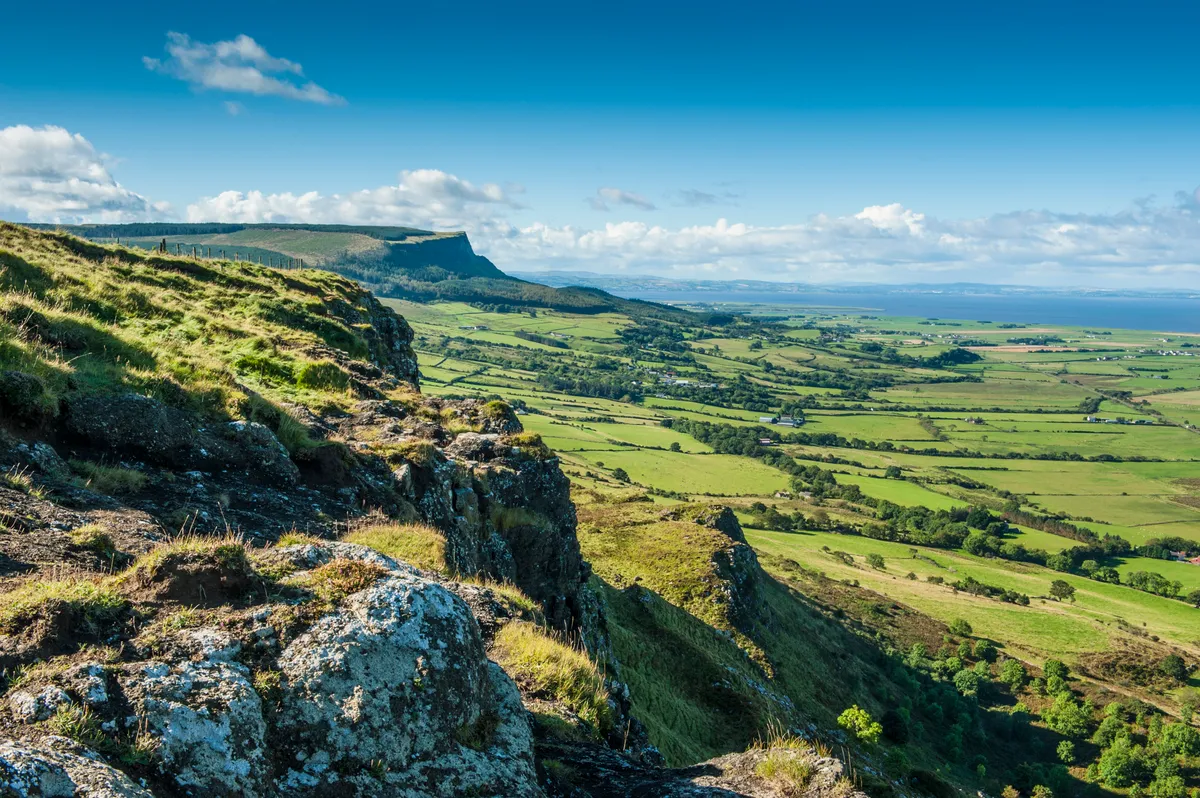
After a paddle in the surf we take on a cobweb-blasting seaside hike towards the dramatic easterly headland, Fair Head. This magnificent 200-metre-high mountain cliff with astonishing vertical dolerite columns is renowned as one of Britain’s best rock-climbing sites.
Scotland’s west coast is on the horizon, but just six miles across the Sea of Moyle is L-shaped Rathlin Island – Northern Ireland’s only inhabited island and tomorrow’s destination.
Puffins and picnics
Serving freshly caught fish and shellfish on the quayside for over 100 years, Morton’s is an institution in Ballycastle. The queue for fish and chips often winds along the road, but we’re in luck, as the fishmonger next door is open (only Thursdays and Fridays).
We add a reasonably priced cooked lobster and a pot of crabmeat to our picnic bag before boarding the catamaran to Rathlin Island.
There’s no doubt wildlife outnumbers the human population (of around 140) on Rathlin; you may even smell the cacophonous seabird metropolis on the cliffs at RSPB’s West Light Seabird Centre (open from April to August) before you walk the 98 steps down the cliff face to see it.
Tens of thousands of puffins, razorbills, fulmars, kittiwakes and guillemots nest every year on these perilous western cliffs facing the Atlantic Ocean. On a viewing platform next to the 106-year-old upside-down lighthouse built into the rock, an RSPB warden hands me binoculars for a closer look.
We’re visiting in late April, the perfect time of year to see puffins bustling in and out of their burrows preparing for their new arrivals.
Rather than wait for the bus, we walk the 4.5 miles across the gently sloping spine of the island back to the harbour, scanning between sheep for a glimpse of a golden hare – a light-haired variant of the Irish hare found only on Rathlin.
Choughs wheel overhead, sea stacks soar and beyond white-topped waves the Causeway Coast’s celebrated basalt cliffs break the line of the horizon.
A rock in the road
Fierce gusts whip and whistle around my ears as I step out on to the alarmingly mobile rope bridge to reach the tiny island of Carrick-a-Rede (from the Gaelic Carraig-a-Rade, meaning rock in the road).
Crouching against the wind, I try not to look down – wooden slats are the only thing between me, a craggy chasm and the swirling, clear, aquamarine waters of the Atlantic almost 30 metres below.
Just 15 minutes from Ballycastle, this was once the site of a thriving salmon industry; catches of up to 300 fish a day were common until the 1960s.
But river pollution and overfishing at sea led to a catastrophic decline in salmon numbers; the industry that had been a local mainstay since the 1620s came to an end in 2002, when Alex Colgan, the last fisherman to hold the licence on the island, shut up shop.
Working here was dangerous and arduous; skilled crews of three to four fishermen would cast the heavy nets from wooden rowing boats, using their knowledge of winds and tides. Now, the tiny fisherman’s cottage hugging the cliffside and the rope bridge – first built in 1755 – are cared for by The National Trust, and fulmars and kittiwakes build their nests on grassy ledges.
A visit to this phenomenal landscape isn’t complete without exploring the 60-million-year-old jewel in its crown and Northern Ireland’s only UNESCO World Heritage Site, the Giant’s Causeway, seven miles along the coast.
The 40,000-plus hexagonal basalt columns tumbling down into the sea are as beautiful and strange as you might imagine.
Despite the crowds, it is possible to take a quiet moment to commune with these ancient rocks, the muse of many an artist. Leave yourself enough time to take a guided tour and hear the mythical tales of Irish giant Finn McCool, then walk up to the Giant’s Organ: a cliffside of soaring trunk-shaped columns.

Taking vows
Ducking past a bridal party taking photos on glorious white-sand Whiterocks Beach – its pale, chalk cliffs carved into caves and monumental arches by weather and waves – we take a vow too: to return to walk the 51km Causeway Coast Way. This stunning coastline deserves a longer explore.
There couldn’t be a better choice for the last meal on our coastal odyssey than Lir – a restaurant beside the River Bann in Coleraine. The brainchild of Rebekah and Stevie McCarry (seen on BBC Two’s Great British Menu), Lir (which means ‘sea’ in old Irish) is a shining beacon on the local food scene, with sustainable seafood at its heart.
My son takes a photo of his whole plaice in caper sauce before devouring every last bite. “We’ll have to come back and try the lobster next time,” he says hopefully. Well, yes, I think we will.