
The battle against harmful invasive marine species has a powerful new recruit. Sgiath,a six-year-old Labrador from the Scottish Highlands, is believed to be the world’s firstdog that’s able to detect Didemnum vexillum, a non-native marine organism, also known as sea vomit, sea snot or carpet sea-squirt.
The mucilage can spread rapidly across harbours, oyster farms and other marine infrastructure, smothering native wildlife and threatening aquaculture businesses. Once widespread, it can be difficult and expensive to remove.
Sgiath’s ability to sniff it out is a breakthrough in fighting the species that’s rapidly expanding along UK coastlines.
The experimental approach has been pioneered by Sgiath’s handler, Dr Texa Sim at Conservation Detection Dogs Scotland. “I used to manage a community-led native oyster restoration project, which had strict biosecurity protocols to prevent marine invasive species colonising the oysters,” Sim explains.
“The difficulty of spotting carpet sea-squirt and reliably identifying it started to make me think about whether a better, more efficient way was possible. When I began to get involved with conservation, detection dog-training and dog-handling, it seemed a natural progression to test whether a well-trained ecology dog could detect and locate the species.”
The International Fund for Animal Welfare (IFAW) recently recognised Sgiath and Sim’s work,with the former rescue dog named Animal of the Year at the charity’s 2026 Animal Action Awards ceremony in London, hosted by Michaela Strachan. Detection dogs are commonly used on land to locate invasive plants and animals.
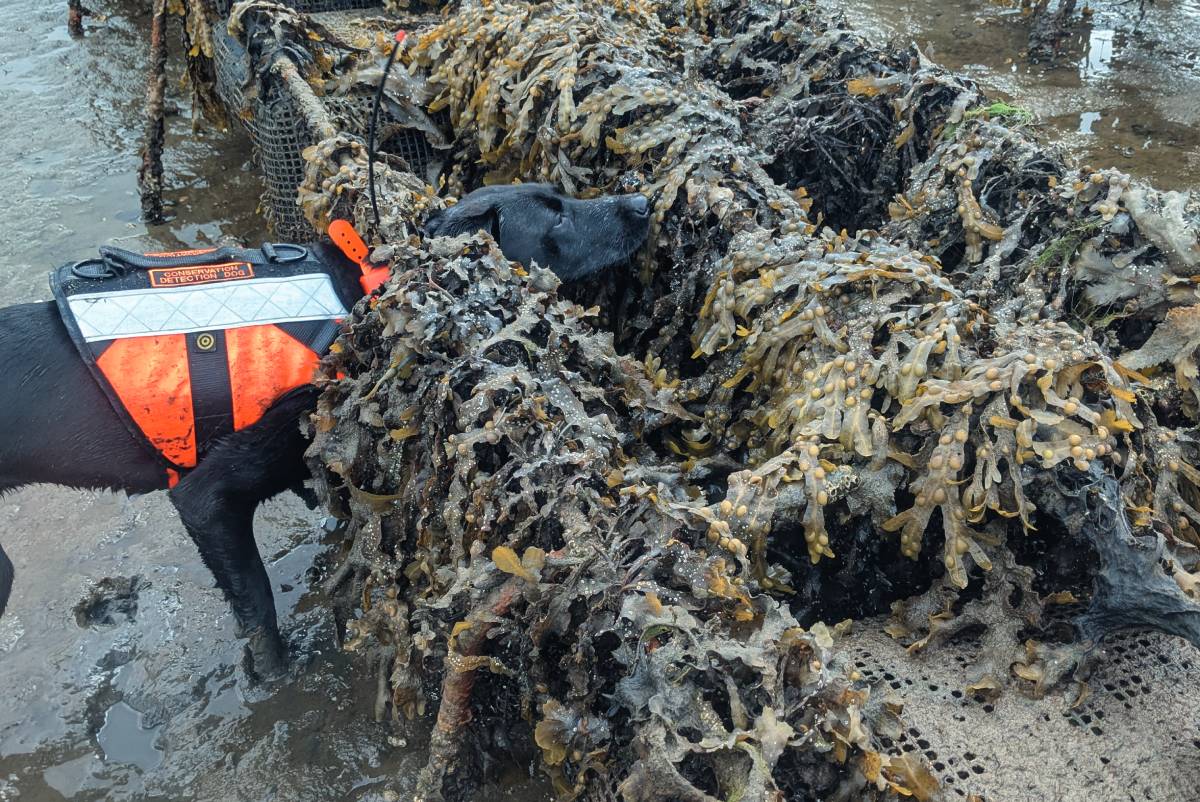
But Sim, originally from Glasgow and now based near Glencoe, has trained Sgiath to paddle along the coast during low tide, sniffing out sea vomit, finding small fragments of the species attached to boat hulls, fishing gear or ropes.
Early detection is considered critical to preventing the species from establishing in new locations. It could become increasingly important as climate change drives warming seas, creating conditions that may allow invasive marine species to proliferate more quickly around the UK.
Sim and Sgiath are now training up Uisge, a three-year-old Labrador that works as a bat carcass dog finding bat mortalities at wind farms, to also help out on marine invasive species detection.
“They’re a talented couple of dogs,” Sim says. “Uisge has progressed with scent-imprinting, which involves learning the sea-squirt scent and then discriminating it against other marine species. She’s now starting field training, learning to apply her skills in the challenging environments of the shoreline. I’m also training the dogs on another marine invasive species, the American slipper limpet, which has recently appeared in Scottish waters and threatens native ecosystems.”
