
Every January, people across the globe come together for a huge celebration to honour Robert Burns, Scotland's national bard.
This legendary figure was born in 1759 in the tiny village of Alloway on Scotland’s south-west coast. He went on to become the most prominent poet to have written in the Scots dialect, penning well-known poems, including To a Mouse, Address to a Haggis and Tam O'Shanter.
He also gave us the New Year's Eve classic song, Auld Lang Syne.
His poetry is timeless, capturing the spirit of rural life, the beauty of the natural world and the charm of the Scottish countryside.
His personal life was colourful too, with passionate love affairs and bold, radical politics. So it's no surprise that Robert Burns is celebrated every year with much feasting, drinking and gusto.
Who was Robert Burns?
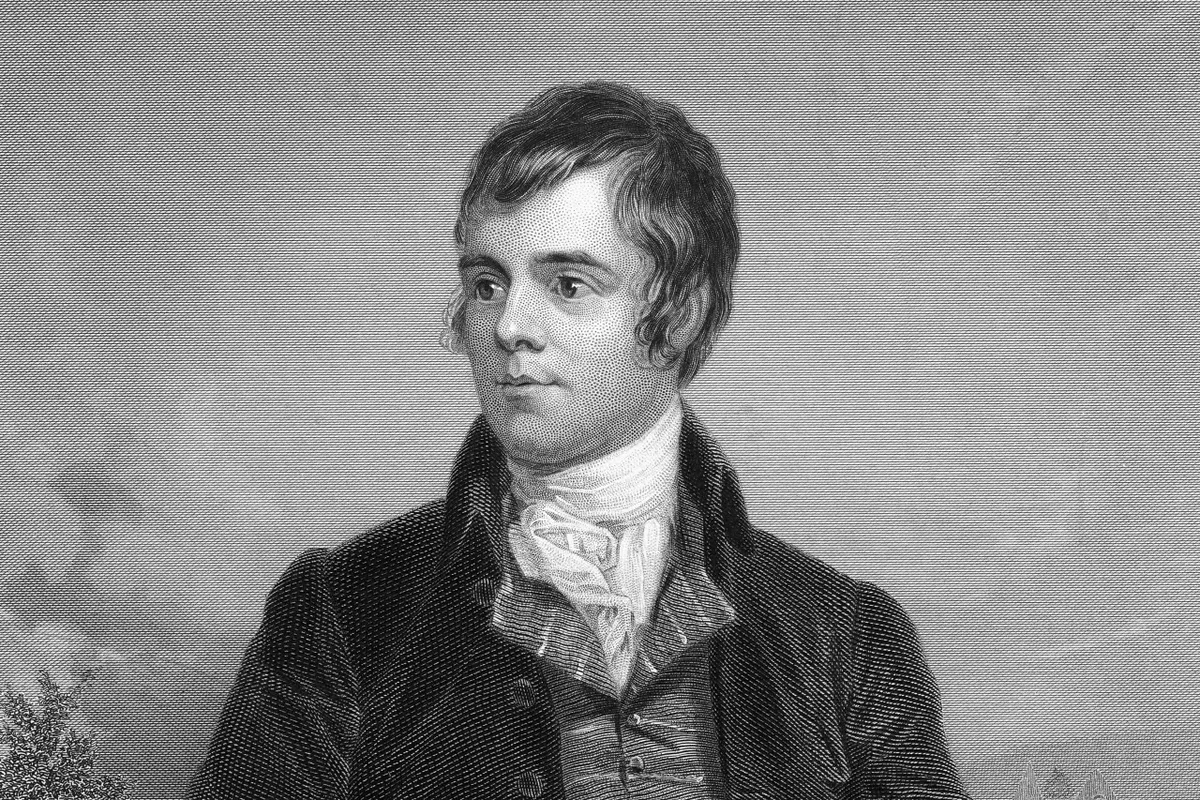
Robert Burns was born on 25 January 1759 in the village of Alloway, Ayrshire, on Scotland’s south-west coast. He was the eldest of seven children of William Burns, a tenant farmer, and his wife, Agnes Broun.
Burns started working in the fields at a young age, and by 15 he had become the family’s primary labourer. It’s this farming upbringing that earned him the nickname 'the ploughman poet'. He was home-schooled by his father.
Growing up, Burns experienced rural life firsthand – its joys and hardships – all of which would later inspire his poetry and songs.
Where did Robert Burns live?
Robert Burns was born in 1759 in Alloway, Ayrshire, at the now-iconic Burns Cottage, where he spent his early childhood. He later lived at Mossgiel Farm and other Ayrshire locations.
He spent substantial time between 1786 and 1788 in Edinburgh, promoting his literary work.
In 1791, Burns moved to Dumfries, where he lived in a house on Mill Street, now preserved as the Robert Burns House, and worked as an excise officer until his death.
Why is Robert Burns so famous?
Robert Burns was a proud Scotsman who wanted to write, not in the same way as famous English poets, but how he spoke.
He drew inspiration from the landscape and people that surrounded him. Working the fields as a child shaped not only his daily life but also the voice that would come to define him.
He found inspiration in the smallest elements – plants, animals and everyday rural scenes – and used these to reflect deeply on human nature, society and morality.
He had a great passion for music and spent years travelling through different parts of Scotland, gathering traditional melodies, recording old verses and refining or rewriting them. Through this work he preserved hundreds of songs that might otherwise have disappeared.
Burns’ literary talent was first noticed when friends encouraged him to publish his poems locally. The 1786 Kilmarnock Edition was an immediate success and brought Burns national attention and soon led to an expanded Edinburgh edition the following year.

From there, word of his talent travelled quickly. Over time, his works spread through published collections and handwritten copies, and also via oral tradition and musical gatherings. He became celebrated not only in Scotland, but across the world.
What is Robert Burns' most famous work?
Robert Burns’ most widely recognised work is undoubtedly Auld Lang Syne, a song that has become a global tradition for ringing in the New Year. It has nostalgic themes of friendship and remembrance.
Beyond this iconic song, Burns is celebrated for widely known poems.
To a Mouse stands out for its compassionate reflection on the fragility of life; My Lurve is like a Red, Red Rose is a lyrical love poem; and Address to a Haggis is a lively, humorous tribute to Scotland’s national dish, now traditionally recited during the annual Burns Night supper.
What are Robert Burns' most famous quotes?
"The best laid schemes o' mice an' men / Gang aft a-gley"
– To a Mouse
Meaning even the most carefully planned undertakings can fail due to unexpected events.
"O wad some Power the giftie gie us / To see oursels as ithers see us!"
– To a Louse
Highlighting how it's good to see ourselves through others' eyes.
"O my Luve's like a red, red rose / That's newly sprung in June"
– My Luve is like a Red Red Rose
What was the cause of Robert Burns' death?
Robert Burns died on 21st July 1796, at the age of 37, in Dumfries. His health, which had not been good for years, was weakened by a rheumatic heart condition. Despite rumours of alcoholism, sexually transmitted disease, lead poisoning and tuberculosis that surrounded his life, experts believe he actually died of a complication of the rheumatic fever he contracted while farming when young.
Who did Robert Burns marry?
Robert Burns married Jean Armour in 1788.
How many children did Robert Burns have?
Robert Burns fathered his first illegitimate child at the age of 25. He went on to have 12 more children, two illegitimate and others that did not survive infancy.
Tommy Hilfiger is famously a descendent of Burns' – he was his great, great, great uncle.
What is Burns Night and why is it celebrated?
Burns Night is celebrated every 25th January to honour the national poet. Revellers enjoy a traditional Scottish supper featuring haggis, Scotch whisky and readings of his poetry.
The first Burns supper took place in July 1801, marking the fifth anniversary of his death, when nine friends gathered at Burns Cottage in Alloway, Robert Burns' birthplace. They recited Address to a Haggis, sang his songs and toasted his memory with whisky.
The night was such a success that it became an annual event, eventually moving to Burns’ birthday, 25th January, and spreading across Scotland, Britain and the world.
- Guide to Hogmanay: history and how to celebrate Scotland’s New Year’s Eve
- Guide to Scotland's North Coast 500
- Britain’s best poetry walks
Why is Robert Burns important to Scotland?
What Scottish clan does Burns belong to?
Burns was its own clan but is also viewed as a Campbell sept.
Was Robert Burns involved in slavery?
In 1786, Burns accepted a job in Jamaica, overseeing a plantation worked by enslaved people. However, he did not take it up. His Kilmarnock Edition collection of poems became popular, and he moved to Edinburgh instead to help bolster his literary fame.
- Britain's best traditional New Year's Eve celebrations
- The Morris renaissance: how the young and stylish are breathing new life into an ancient folk dance
- Is haggis banned in the US?
- Isle of Skye distilleries: 4 must-visit whisky makers
Main image: Robert Burns statue by Amelia Paton Hill in Dumfries, Scotland, where the poet lived from 1791 until his death in 1796. Credit: Getty Images


