Helen Macdonald’s memoir H is for Hawk explored the romance of falconry, nature’s transformative power and the ferocity of grief. Mark Bailey meets the author as her tale becomes a star-studded movie.
- Podcast: Interview with H is for Hawk author Helen Macdonald in the latest BBC Countryfile Magazine podcast
- Where is H is for Hawk filmed? All the locations used in the movie based on Helen Macdonald’s memoir
On a crisp winter morning in Hawkedon, West Suffolk, frost covers the village green and mist wreathes the corrugated fields beyond the church. Inside a cosy cottage alive with the chatter of birds, Helen Macdonald is talking about the day she became a ghost.
H is for Hawk
Back in 2014, the writer (who now identifies as non-binary, and is happy to be referred to as she or they) released H is for Hawk – a uniquely intelligent, eccentric, harrowing and profound memoir.
The book chronicled the year that Macdonald, then an academic in the history and philosophy of science department at Cambridge University, trained a Eurasian goshawk as a way to navigate the swirling vortex of grief that followed the death of their father, Alisdair Macdonald, a respected press photographer.
- The elusive 'phantom of the forest' is expanding its range – scientists tracked 29 of them to find out more
- "At speeds in excess of 200mph it will power down, headfirst, into the wing of its prey" – deadliest birds of prey in the UK
The memoir won the Samuel Johnson Prize and the Costa Book of the Year and touched thousands of people struggling with grief. Now, a film adaptation has been released, which stars Claire Foy (Wolf Hall, The Crown) as Helen and Brendan Gleeson (In Bruges, The Banshees of Inisherin) as Alisdair.
“There were moments that have been very weird,” admits Macdonald, 55, nursing a mug of tea and sharing a plate of mince pies.
“When I went to the set it was in dank October, mid-afternoon and getting dark. I’m in my old college, Jesus College, which is transformed, full of giant lights and people. And in the cloisters there’s Claire Foy, dressed as me, carrying a goshawk. And (Irish actress) Denise Gough dressed as my friend Christina. And I had this incredibly dizzy moment. It felt like I was a ghost watching myself in the past.”
Macdonald’s memoir is deeply personal. Was it not painful to hand control over to director Philippa Lowthorpe (The Other Boleyn Girl) and screenwriter Emma Donoghue (Room)?
“It wasn’t difficult, for a couple of reasons,” insists Macdonald. “One is that it took me seven years to start writing H is for Hawk after losing my dad [in 2007]. I needed to take that time in order that the person that I was writing about – i.e. me – became a character in my head. But also writing a book is a bit like being a potter throwing a piece on a wheel. You’ve used all your skill to make something, and when it’s done, it’s done. You take it off and you fire it. And then you put it on a shelf for someone else to use.
“I was asked: ‘Do you want to be involved?’ And I said: ‘Absolutely not!’ One, I’ve not done any drama writing. And two, it would just be the same. Let’s give it to someone else and see what they make of it.”
- Day Out: The Brecklands, Norfolk and Suffolk
- A wander in a bird of prey sanctuary with Megan McCubbin

Untameable grief
Macdonald had been enchanted by hawks since childhood. Aged eight, she devoured Arthurian novelist TH White’s nature classic The Goshawk (Macdonald’s memoir is also a shadow biography of White). Aged 13, she trained a European kestrel, Amy, who roosted on her bedroom bookcase.
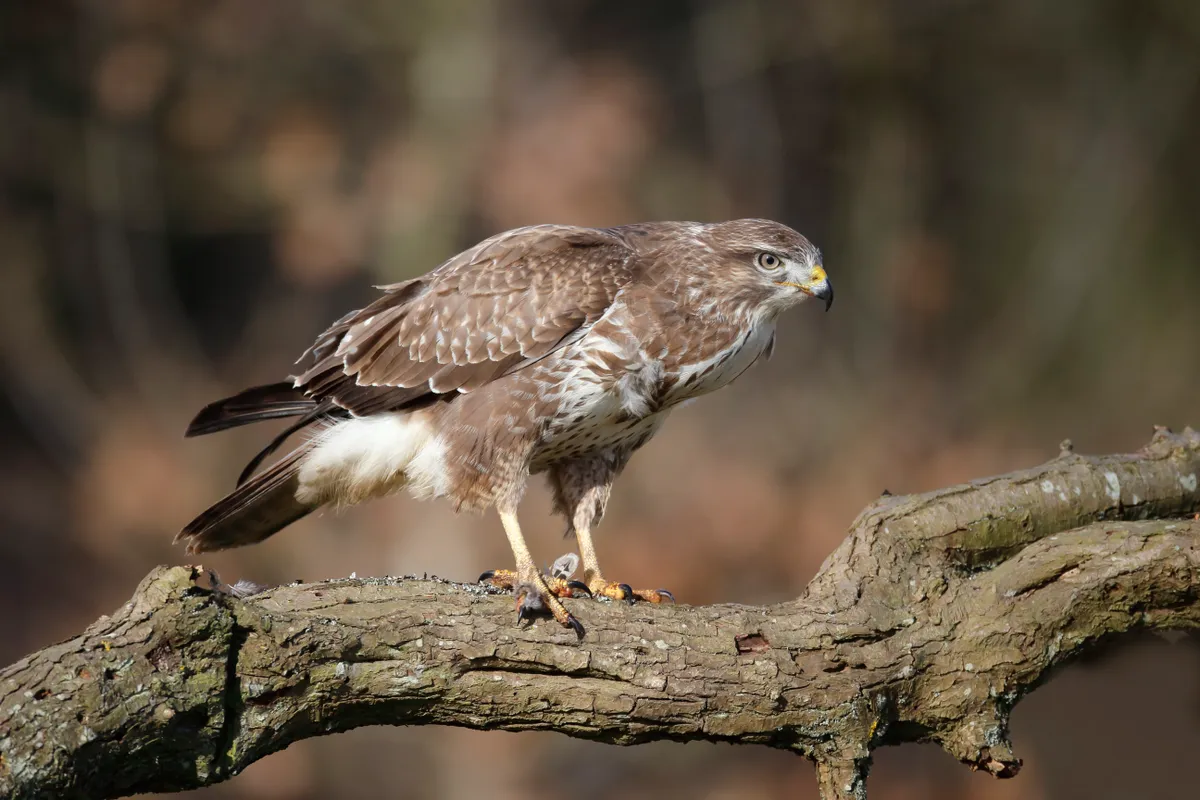
But following Alisdair’s death, Macdonald longed to train a goshawk because its fabled murderous ferocity matched her own wild, untameable grief. She bought one for £800 from a legal dealer online, collected it from the docks in Stranraer and named her Mabel.
H is for Hawk chronicles Macdonald’s pain and isolation as she flees human society and dissolves into the bleakly beautiful Cambridgeshire landscape with Mabel. From feeding Mabel raw steak to taking her hunting for rabbits, Macdonald’s bond with Mabel triggers a deep exploration of life and death, beauty and pain, solitude and love.
At first, training Mabel was an escape: “It was all absorbing and completely magical, and it stopped me thinking about grief… The hawk was everything I wanted to be: all the rage and wildness of grief, all the things I couldn’t control.”
But in time Mabel taught Macdonald to understand death and accommodate change. A hawk can be tamed. Grief cannot.
Macdonald learned to live with – not fight against – that grief: “I learned to be more human once I knew, even in my imagination, what it was like to be not.”
An acceptance of love
The writer admits she was “completely bonkers” for a while, and even her brother and mother were worried.
“Just don’t get lost,” warns her mother in the film. But her epiphany was to recognise the universal presence of love.
“People think the film is about death but the film is about love,” says Macdonald. “Parental love. Sibling love. Love between friends. And love for a Photos: hawk. In the movie, ‘Claire-Helen’ is desperately turning from all that love, and then realises it is all around her.”
Helen Macdonald’s writing is so intensely introspective that journalists are often shocked to find she is giggly company in person.
- Brutal birds of prey photos and videos that showcase the raw strength and deadly power of Britain’s most formidable hunters
- "Gripping and poignant": first-time authors win 2025's prestigious Wainwright Prize for nature writing
Today, the author breezily dismisses the crystalline beauty of her writing as “cod-Shakespearean”, and whispers “quiet, sweetie” to Bertie, their domestically bred yellow-shouldered Amazon parrot.
Endearingly, whenever a blackbird darts past the window Macdonald’s gaze turns instinctively towards it. But Macdonald’s hawk-like qualities are most evident in the ferocity of her intelligence.
When writing, she ruthlessly tears her subject matter to shreds in a hunger to discover the deeper truths buried beneath the bones of cliché that afflict so much other nature writing.
Perhaps this is why Foy, despite enjoying a Zoom call with Macdonald before filming, felt she wanted to keep a “respectful distance” to avoid feeling “intimidated” by the challenge of portraying such an impressive living person.
The respect is mutual. “She’s a Claire-Helen,” says Macdonald. “Claire happens to be a naturally brilliant falconer. And she is so petite she makes the hawk look enormous!”
Admirers of the book may mourn the absence of Macdonald’s beautiful language, but film is a different medium. “I expected that there would be a sort of Blade Runner-esque interior monologue, because the book is so much my internal thoughts,” admits Macdonald.
“But it is beautifully quiet. And I think they played a blinder with that. Because when I was training my hawk the great problem I had was that she couldn’t speak back to me, so I could project myself into her.
“And in the movie Claire is quiet enough that everyone watching it is able to see that, and to feel what it is like to be a grieving child. So the film matches what happens in the book, just in a different way.”

Adapting for film
Filming took place in South Wales and Cambridgeshire and the brooding British landscape is elegantly showcased through gorgeous cinematography.
“I’m a very visual person,” says Macdonald. “The filmmakers captured the environment in which Mabel and I were in, which is a cloudy, misty, sharp autumn and winter in the English countryside.”
Five birds were used to portray Mabel, who died of aspergillosis in 2014. The movie captures the visceral intensity of a hunting hawk.
In the film, Mabel’s breeder declares that the secret to a happy goshawk is “murder: it calms them right down”.
As Macdonald explains: “Living with Mabel taught me about life and death. It showed me in a way that I think most people don’t get to see how tiny the division between life and death is. Something is alive one minute and dead the next. And it’s a bizarre mystery.”
Macdonald would often dispatch Mabel’s prey to minimise its suffering. “Goshawks have these enormously powerful feet, they grab an animal, and they just start eating. But if I run up to a hawk with a rabbit or a pheasant, I can’t just let that happen.”
The experience has left Macdonald more respectful of life: they eat meat, but less of it.
“It just makes you think about responsibility, and about the fact that [chicken] nuggets are real creatures.”
In the decade between the release of the book and the movie, Macdonald has been overwhelmed by how many people have shared their own stories of grief.
“There’s something about H is for Hawk that allows people to talk about things that society generally finds difficult, private, uncomfortable,” explains Macdonald. “And the movie does the same, which I think is a bit of really, really rare magic.”
Life's rich tapestry
Macdonald dislikes the idea of nature as therapeutic, not because it isn’t, but because it encourages us to think that nature exists for our own benefit. On walks today, Macdonald prefers to look with humility and respect. Their father’s patience as a photographer (“Watch carefully so you remember what you see”) nurtured a quality of attention.
“It’s a sort of trick,” they explain. “If you look with extreme attention at everything around you, and try not to accord everything different weights, you see that the corner of a cloud is as important as the side of a leaf that you tread on. It sounds ridiculous!
“But on walks I think about how much life is around me. And the Earth belongs to them as much as it does to me. You realise that you’re just part of this rich and complicated world. And it’s emotionally and intellectually important to do that.”
Over time Macdonald’s gaze has shifted closer to home: to the jumping spiders outside the house, the house martins in the eaves and the green woodpecker hunting ants on the lawn.
“You can get as good a sense of the wild from looking at the spider in your kitchen than by watching stags in the Scottish Highlands. These things are just as wild, just as inhuman and just as extraordinary.”
The deep introspection, which once threatened to tear Macdonald apart, is now the gift that keeps the writer grounded as publicity around the new movie reaches a peak.
“My life is really quiet,” insists Macdonald. “I’m just writing and taking the parrot for walks. So I’m afraid the eccentric quotient continues to be quite high…”