
Britain’s birds of prey are often admired for their beauty and aerial mastery, but beneath the elegance lies formidable hunting power. From the vast coastal wingspan of the white-tailed sea eagle to the almost invisible night-time strikes of owls, these raptors are among the most efficient predators in the natural world.
Armed with razor-sharp talons, hooked beaks and extraordinary eyesight, they have evolved a diverse array of techniques to catch, kill and consume their prey. This guide explores the deadliest birds of prey found in Britain today, not as villains, but as finely tuned hunters whose success is vital to the balance of our ecosystems.
- 10 deadliest birds on the planet: From slashing humans with razor sharp talons to kicking prey to death, discover the world's savagest, most brutal avian killers
- 10 brutal birds of prey photos and videos that showcase the raw strength and deadly power of Britain’s most formidable hunters
UK's deadliest birds of prey
White-tailed sea-eagle – the coastal giant

With a body that stands 3ft tall, a wingspan of almost 8ft (2.4m) and broad, almost rectangular wings, not for nothing is this bird of prey nicknamed the ‘flying barn door’. Its noble head ends in a chunky yellow beak with a wicked curved tip and it stands on sturdy yellow legs that end in large, powerful feet and muscle-piercing talons.
White-tailed eagles have the alternative name of sea eagle which reflects their preferred habitat close to the coast. Their location enables them to hunt on land or sea for prey that includes small mammals, medium-sized birds and both fresh and saltwater fish.
Carrion is also an important component of their diet, including in spring afterbirths and dead lambs, which is what led to their reputation as a killer of livestock. So unpopular were the birds that they were persecuted to extinction in the 19th century. We can enjoy the sight of them in the UK today thanks to a reintroduction programme and a determined effort to change perceptions of this magnificent animal.
Golden Eagle – iconic highlander

In the UK, this raptor is second in size only to the white-tailed eagle, although its body is slightly longer. It is a bird of the moors and mountains of Scotland and Northern Ireland and, as with all eagles, a formidable hunter. Goldies predate on rabbits, Arctic hares, foxes, ptarmigan and red grouse, roe and young red deer. They have speed and agility, hugely powerful feet to grasp and hold onto prey and large curved beaks to deal with even tough hide.
- Where to see a golden eagle in the UK
- What’s the biggest eagle in the world? Meet the contenders – including a giant with a monster 3-metre wingspan
Golden eagles spend most of their day perched in a tree or on a rocky outcrop, venturing aloft in the early morning or later in the afternoon to catch updrafts and thermals. These air currents assist them in their soaring flight so they do not have to indulge in much flapping. In winter they spend slightly more time airborne as live prey is not so available. In this season, more than at other times, they will feed on carrion to cope with lean times.
As they hunt they survey the land from a great height, flying at a steady 30mph and using their acute vision to spot their prey in amongst the vegetation on heather hillsides. Once a meal has been located, they can put on a stunning display of speed in a dive, reaching between 150 and 200mph.
Osprey – accomplished fisher

This striking fish-eater can be found on practically every continent in the world, but it is only in relatively recent times that it has once again made its home in the UK. Ospreys are not popular with fishermen, particularly the owners of commercial fisheries and their eggs are highly prized by illegal collectors as each mottled brown and white egg has a unique patterning.
- White-tailed eagle vs osprey: what's the difference between these two stunning birds of prey?
- Watch incredible, unbelievable close-up footage of baby ospreys hatch and grow, surviving storms and brutal tawny owl attacks
The adult bird’s plumage is similarly unique, which attracted skin collectors in Victorian times. As a result of this persecution, the birds had ceased to exist on these islands by the late 1940s. In the 50s some birds naturally recolonised parts of Scotland and then in 1996 licences were issued to import chicks to secret locations in England. Since then the species has successfully bred in many UK locations.
- Your 60 second guide to osprey fishing behaviour
- Ospreys' migration: a guide to when, where and how long these magnificent birds travel for
The osprey is a highly specialised hunter, scanning the surface of water watching for the movement of a fish. Once spotted, it dives straight down, feet first, altering its position as it drops to take account of the water refraction distorting its prey’s position. It can close off its nostrils to prevent drowning and its dense feathering resists waterlogging. Its powerful 6ft-wide wings haul it back out of the water, even if it has become completely submerged.
Ospreys are strong enough to lift a 2kg fish, even though they are around that weight themselves, and they have reversible toes with sharp barbs to cope with the slippery scales. Once aloft, they will shift their vice-like grip on the wriggling fish to carry it fore-and-aft to a perch where it can be consumed.
Red Kite – easy glider

Another victim of heavy Victorian persecution, by the middle of the 20th century red kites were only clinging on to territories in Wales and had disappeared from the rest of the UK. In the 1990s concerted efforts were made to reintroduce the birds to the Chilterns, the East Midlands, Yorkshire and other areas of northern England.
Just 30 years later the red kite project has proved to be the country’s most successful reintroduction and conservation effort. As an example, 13 kites released in the Chiltern Hills’ area west of London in 1990 have multiplied to around 4,000 breeding pairs today. Critics have been convinced of the value of these scavengers and their negative reputation for taking significant numbers of live prey have been put to rest.
Red kites are the largest of Britain’s common birds of prey, well-known for their graceful gliding flight in their search for carrion. They can often be chanced upon on a country lane while they are clearing up roadkill. They do hunt small mammals and birds in lean times, but generally red kites prefer to feast on the already dead, swooping in on massive wings to grasp it with their talons and carry it away.
Northern Goshawk – rare but impressive
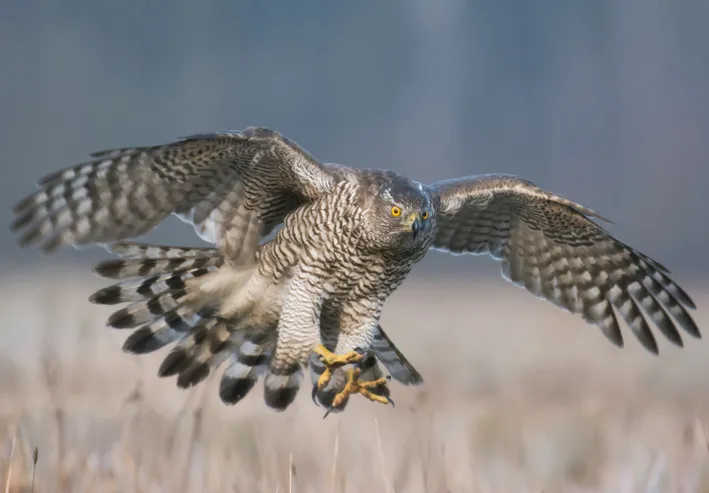
Heavier than a red kite but smaller than a buzzard, with shorter wings and body, goshawks will go after rabbits, squirrels and other bird species less sizeable than itself in its woodland home. They are powerful and aggressive dive bombers and fly at speeds up to 40mph, weaving skilfully in and out of the trees like skiers on a slalom slope.
If they feel threatened they will go on the offensive, whether facing other animal predators or human beings, attempting with curved beak and sharp claws to intimidate and drive away. As the bird is capable of inflicting painful cuts and scratches, it might be said to be fortunate that there are not very many of them scattered across the UK – from 280 to 430 pairs – and so the chances of ruffling the feathers of one of them is quite remote.
But they are strikingly attractive raptors, useful in keeping down rodents in plantations and rabbits and pigeons in crop fields.
Peregrine Falcon – Formula 1 raptor
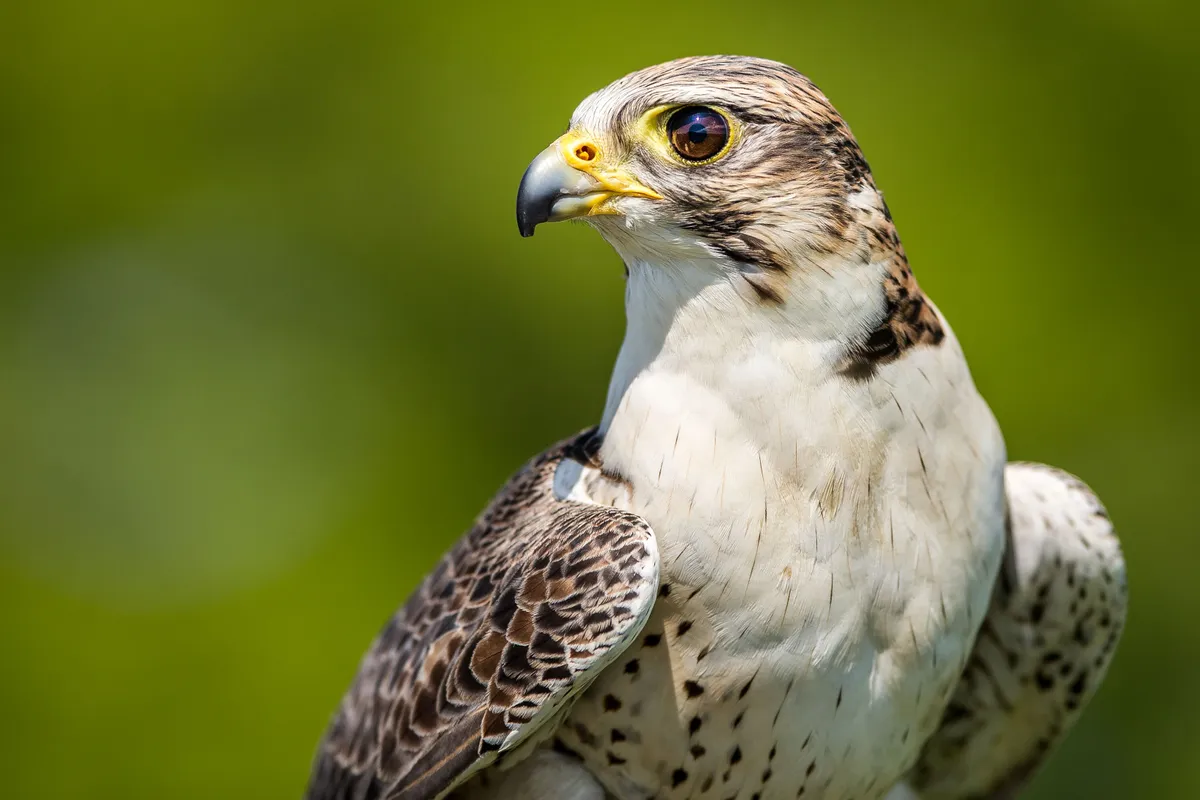
Speed is the superpower of this scourge of the feral pigeon world. At speeds in excess of 200mph it will power down, headfirst, into the wing of its prey, knocking it off balance and leaving it vulnerable to a sweeping catch and rapid dispatch. The reason for this strike approach is to preserve the safety of the peregrine, as hitting a pigeon body at those speeds could break the attacker’s neck. A flexible wing offers less of a solid obstacle but is no less devastating a blow for the victim.
- It is the fastest animal in the world and can catch its prey mid-air in its deadly claws: Meet one of the world's most incredible birds of prey
- World's fastest predator attacks huge flock of starlings in Cheshire
A second clever adaptation in the peregrine’s make-up is the structure of its nasal passages. Because it travels at high speed there is a danger from rapidly changing air pressure damaging its airways. Small bony tubercles in its nostrils are thought to divert the air away so the bird can continue to breathe effectively. In addition, its eyes are designed to process very rapid movement as it plunges and maintain steady vision even at high speed.
Common Buzzard – available nationwide

The buzzard is Britain’s most abundant bird of prey, found practically everywhere - in dense woodland, moors, scrub and farmland, around villages and even towns. They can be seen soaring and spiralling high in the air, perched on a fence post or telegraph pole, or mooching around on the ground keeping a sharp eye out for rodents in the long grass. Sometimes you will see them digging in a roadside verge for earthworms or looking for caterpillars and large insects in the vegetation.
Buzzards co-exist happily with red kites and between them these two iconic birds of prey cause much anxiety and aggression amongst local corvid populations that will attempt to mob and harry them out of their area.
Buzzards have a wide range of colour variations, including red, which can confuse if they are seen in the same habitat as red kites. However, they have a short, rounded, convex tail, as opposed to kites where the tail profile is concave with pointed ends. In mountainous areas they can also be confused with golden eagles, although the latter holds its wings flat as it glides, whereas a buzzard will adopt a V shape. It also has a shorter tail and neck.
Marsh Harrier – wetland specialist

Once very rare – to the extent that only one pair of marsh harriers was recorded as nesting in Suffolk in 1971 – they have benefitted from conservation efforts and are now thought to number around 700 pairs mainly across the south and east coasts of England, with some in the north west and isolated spots in Scotland.
Some 70% of that UK population, though, is found in East Anglia in the summer months. The birds generally migrate between Europe and Africa, arriving in Britain to breed in the spring, although there are now some birds that are resident all year round.
Marsh harriers are swift, agile fliers and efficient hunters. They are known for their display flights over the reeds, with the females flipping upside down and locking talons with the males. The males often perform impressive mid-air food passes to their mates.
As the name implies, marsh harriers inhabit wetlands, estuaries and reedbeds where they predate on small mammals, small- to medium-sized waterbirds, frogs and toads. Once the UK’s least common raptor, their numbers are sharply rising, and there are now over 500 breeding pairs. Marsh harriers are subtle, swift and incisive hunters that target an array of
Marsh harriers are compact raptors, though larger than other harriers.
Tawny Owl – stealth bombers

This is the UK’s most common owl, widespread throughout much of England, Wales and Scotland, although not in the Scottish highlands and islands or Northern Ireland.
Because they are nocturnal, only the size of a wood pigeon and very well camouflaged in their daytime roosts, they are not easy to spot. But anyone who has been outside near broadleaf woodlands at night will most likely be familiar with their ghostly ‘kerwik’ and ‘hoo-hoohoo’ calls as male and female communicate. They live in pairs and are highly territorial so once you have heard the calls it’s worth revisiting the location in hope of eventually seeing a bird.
- What's the most common owl in the UK?
- Tawny owl guide: how to identify, what they eat - and the secret behind their musical hoot
Mice, voles and other small mammals, as well as frogs and earthworms are on the menu for tawnies. Their eyesight in the dark is exceptional and their field of vision narrow so they can focus in on their small prey like a birdwatching with binoculars.
To compensate for not having an expansive visual field they have special muscles and blood vessels in their necks that allow them to rotate their heads almost 360 degrees. This has the added advantage of allowing the bird to survey the rodent scene without making a noise by moving its body. Almost silent flight aids a swooping, undetectable attack.
Short-eared Owl – daylight predator

Unlike the tawny owl, short-ears will hunt during the day over moors, farm land and wetlands, favouring early mornings and dusk. They also hunt at night but generally they will follow the movements of their favourite vole prey, so if the rodents are active during the day so will be the owls.
While on the prowl they will glide close to the ground, ready to pounce feet-first on a fleeing meal. In coastal areas they will also predate some of the smaller seabirds and inland they are not above taking squirrels, bats and flying insects.
Short-eared owls are found all over the world, apart from in Australia and Antarctica. In the UK there are resident birds in northern England and southern Scotland but they are augmented in winter by the arrival of owls from Scandinavia, Russia and Iceland who come to other parts of the country for their ‘summer’ holidays away from the freezing temperatures of northern Europe. The ‘ears’ are not true ears but tufts of feathers on the tops of their heads that they raise if they are alarmed. The tufts are short, though, so they are often not easy to see.
Long-eared Owl – shy night bird

Another vole lover, long-eared owls are much more numerous in the UK than short-ears but not so universally spread across the country. Residents live in coastal areas around the north of England, Scotland and Northern Ireland. Winter visitors congregate in the Midlands and along the south coast. There, they hunt for small mammals and, occasionally, birds if times are hard. Their killing technique involves snatching up their prey and biting the back of its neck to paralyse it before tucking in.
Long-ears can be confused with short-ears as they are similar sizes, but these are very secretive birds, flying and hunting only at night. You need to be familiar with the location of a roost and have sharp eyesight in order to have any chance of seeing one during the day. The ‘ears’ on the long-eared are more prominent than the short-ear’s, looking like miniature horns. But if the birds are not alarmed in any way the tufts of both are flat to the head, removing the most distinguishing differentiation.
Barn Owl – silent killer

Known by some as the ‘ghost bird’ this pale-coloured nocturnal hunter is completely silent in flight. This is thanks to feathers on their foremost wings that are equipped with rows of tiny hooks. These deaden the sound of the air passing over the wing’s leading edge to make its flapping undetectable.
The wings are also very large, relative to the body size, and the feathers covered in hair-like structures that smooth the airflow and prevent the bird from stalling. This means it can hover with ease and fly very slowly to survey a grassland for signs of rodents. Unfortunately, it also makes the feathers less waterproof than other birds and so they cannot hunt in very wet weather for fear of becoming waterlogged and chilled to death.
Barn owls have relatively long legs, which helps them capture prey in long grass. Their visual perception of movement is keen, and they have superb night vision. They also have very acute hearing to pick up the merest whisper of a vole on the move.
Barn owls are resident all over the UK apart from the Scottish highlands and islands, the Peak District, mid-Wales and north Northern Ireland.
Two other deadly raptors that can occasionally be found in Britain.
European Honey-buzzard – unusual eaters

The UK’s honey-buzzard population is very small, just an estimated 100 pairs, so they are an exciting find for birdwatchers. In summer they occupy areas of the south coast of England, mid-Wales, parts of East Anglia, the area around the Cairngorms in Scotland and a few other very small spots in the rest of England and Scotland. They can possibly be more often seen all along the east coast of Britain as they pass over on migration.
Honey-buzzards have a curious diet compared to other raptors. They delve into bee and wasp nests in search of the larvae. It is this dietary habit that gave rise to their name, as in ancient times they were thought to be raiding the insect nests for honey. The birds are protected from the stings of angry bees by scale-like feathers on its head that are also thought to contain some form of wasp deterring chemical. Whatever its defences, they are powerful enough to protect the honey-buzzard from Asian hornets and they are the only bird known to predate these dangerous insects.
Hen Harrier – most persecuted bird

The hen harrier has been the subject of much heated debate in UK uplands. Seen as Public Enemy Number 1 by many moorland owners and gamekeepers because of its predation of red grouse chicks, it has been persecuted almost to extinction in the country.
It hangs on in isolated areas of Scotland, particularly the Scottish islands, as well as the Isle of Man and North Wales, but elsewhere unscrupulous shooting interests have poisoned, trapped and shot it out of existence. However, these harriers now have protected status legally and much effort is being made by conservation groups and amenable landowners to lessen conflict. The hope is that improving conditions for the birds will rapidly restore their populations around the UK.
Despite their reputation in certain quarters, hen harriers’ diet consists mainly of voles and meadow pipits, not grouse, although it can’t be denied that young grouse make an obvious but incidental substitute for the latter in the appropriate season. Harriers hunt by flying backwards and forwards over a chosen area, close to the ground so they can listen for the rustling of prey in the grass and heather. They make a striking sight if you are lucky enough to find one.

![A Yellowhammer [Emberiza citrinella] Perched on a fence post. Picture taken on the 7th of June 2018. Swindon, Wiltshire, England](https://c02.purpledshub.com/uploads/sites/47/2025/04/why-are-birds-yellow-scaled.jpg?w=1200&webp=1 "Yellowhammer [Emberiza citrinella]")


