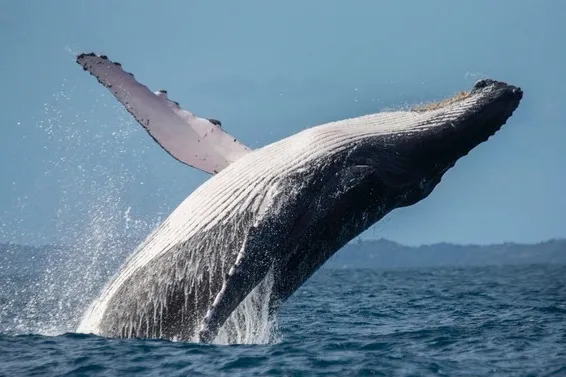
Humpback whales like to travel and the males like to sing, attributes that, along with their spectacular acrobatics, have made them one of the most iconic species of whale in the ocean, say the experts at Whale and Dolphin Conservation.
They live a life of two halves, spending months fattening up in colder, high latitude polar waters like those around Iceland and Norway, before heading to warmer, shallow low latitude breeding areas in tropical and sub tropical waters for the second part of the year.
- What's the biggest whale in UK waters? And just how big is it...?
- What's the most common whale in UK waters?
During these mammoth journeys they are being sighted more and more off the coast of the UK. This may be due to increased awareness, a possible indication of population recovery – or an underlying warning signal of a shift in distribution and feeding patterns as seas warm.
What do humpback whales look like?
Humpbacks are large, robust whales with knobbly heads, large light-coloured flippers and powerful tails. Their pleated throats expand like an accordion when gulp feeding and their broad tail flukes are often lifted high before a deep dive. Their scientific name Megaptera means “large-winged,” referring to their remarkably long pectoral fins — the longest of any whale.
Humpbacks have dark backs and patchy, pale undersides, as well as distinctive white and black pigmentation on the underside of their tail flukes. They will also have distinctive scars and barnacle clusters on their bodies its body. Their markings allow scientists to identify individuals, often tracking them over decades.
How big are humpback whales?
Humpback whales are usually between 14–16 metres long and weigh between 25–40 tonnes. Females tend to be slightly larger on average.
Where do humpbacks live?
Humpbacks are one of the ocean’s wanderers and can be found in all major oceans, from polar feeding grounds to tropical breeding areas. They generally avoid the extreme Arctic and Antarctic pack ice and prefer to hug more coastal waters during their long migrations.
Why are they called humpback whales?
Their common name comes from the distinctive hump formed by their dorsal fin and arched back as they prepare to dive.
- World's rarest whales and dolphins: 10 beautiful cetaceans in danger of disappearing forever
- Beaked whales are one of the strangest, rarest and deepest-diving marine mammals in the ocean - sometimes diving more than 2.5km down
Do they have teeth?
Like other baleen whales, humpbacks have no teeth. Instead, they have around 270-400 baleen plates on each side of the mouth, which they use to filter krill and small fish from the water.
What do humpback whales eat?
The prey of humpback whales are tiny compared to their own bulking mass. Feasting on plankton, small shrimp-like crustaceans such as krill and small schooling fish (such as sand eels, herring and mackerel), they need to eat a lot to survive. In fact, an adult humpback whale can consume up to 1360kg of food each day.
How do they track their prey?
Humpbacks may locate prey using acute hearing but they can employ an ingenious method to trap them. Bubble-net feeding behaviour involves creating spirals of bubbles to trap fish, then lunging upwards through the centre with mouths wide open — a remarkable example of teamwork and intelligence.
How fast can they swim?
Travelling between 3-9mph, the humpback is not built for speed but can reach around 16mph for very short periods of time if a threat emerges.
Do they form pods or super pods?
Humpbacks are usually sighted in small groups, but large aggregations may form when feeding or breeding. Temporary groups of several individuals may form during feeding frenzies or cooperative ‘bubble-net’ hunts, where whales work together to confuse and corral fish using rings or clouds of bubbles.
How do they breathe?
Humpbacks breathe through a pair of blowholes on top of their heads. When they exhale the resulting blow can reach several metres high.
Do they come to the surface for long?
During feeding, humpbacks surface frequently, often taking several breaths in quick succession. On long dives, they may stay underwater for 10-20 minutes, sometimes longer when foraging in deep water.
How long do humpbacks live for?
Humpbacks can live for 50-70 years, with some individuals possibly reaching 80 or more.
How intelligent are humpback whales?
Humpbacks demonstrate complex behaviours, including sophisticated vocalisations and communication, cooperation during hunting, and even evidence of social learning and cultural transmission – passing on learned songs and knowledge like feeding techniques between populations.
There are documented cases of humpback whales assisting companions who are entangled in fishing gear, as well as engaging in play activities. As a social mammal, they are known to be intelligent (possibly comparable to primates).
Do they interact with other species of whale or dolphin?
Humpbacks are known to interact with other species, often feeding alongside fin whales, minke whales and dolphins. They have also been observed intervening to protect their young and even other marine mammals from orca and shark attacks.
How long will the calf stay with his or her mother?
After an 11-12 month gestation, calves are born in warm tropical waters and nurse for around a year. They often remain with their mothers for up to two years, learning migration routes and survival behaviours.
What sounds do humpback whales make?
Humpbacks are the true singers of the sea. Males produce long, complex songs that can last up to 30 minutes and travel for several miles underwater. These haunting melodies are thought to play a role in communication and courtship.
Do they have natural predators?
Orcas are their main natural predators, mainly targeting calves. Adult humpbacks, however, are rarely attacked.
How do they protect themselves?
Humpbacks will use their size and powerful tail flukes as a form of defence. They are also smart enough to use cooperation, and sometimes aggressive displays to deter threats.
What are the main threats to humpback whales?
- Entanglement in fishing gear
- Ship strikes
- Ocean noise pollution
- Climate change (impacting krill and fish stocks)
- Plastic and chemical pollution
Are humpback whales endangered?
Once hunted to near extinction, following a ban on commercial whaling in 1966, many humpback whale populations have shown significant recoveries. They are now listed as Least Concern by the IUCN. However, hunting still occurs in some places (such as Greenland and the Eastern Caribbean), and populations (such as in the Arabian Sea) remain vulnerable and endangered and in need of protection from other human threats.
What is the scientific name?
The humpback whale is Megaptera novaeangliae, a member of the baleen whale family known as the rorquals – the same group that includes blue, fin and minke whales. These are the large, toothless whales that filter-feed using baleen plates instead of teeth.
What is the classification?
Kingdom: Animalia
Phylum: Chordata
Class: Mammalia
Order: Cetacea
Family: Balaenopteridae
Genus: Megaptera
Species: M. novaeangliae
When did humpback whales first appear?
Studies of ancient fossils suggests humpback whales evolved around 10-12 million years ago – a period known as the Miocene epoch.
When were they first described scientifically?
The humpback whale was first identified in 1756, and described by German naturalist Georg Heinrich Borowski in 1781. The name Megaptera novaeangliae translates roughly as “big-winged New Englander” – a nod to its enormous flippers and the region off the east coast of North America, where early specimens were studied.