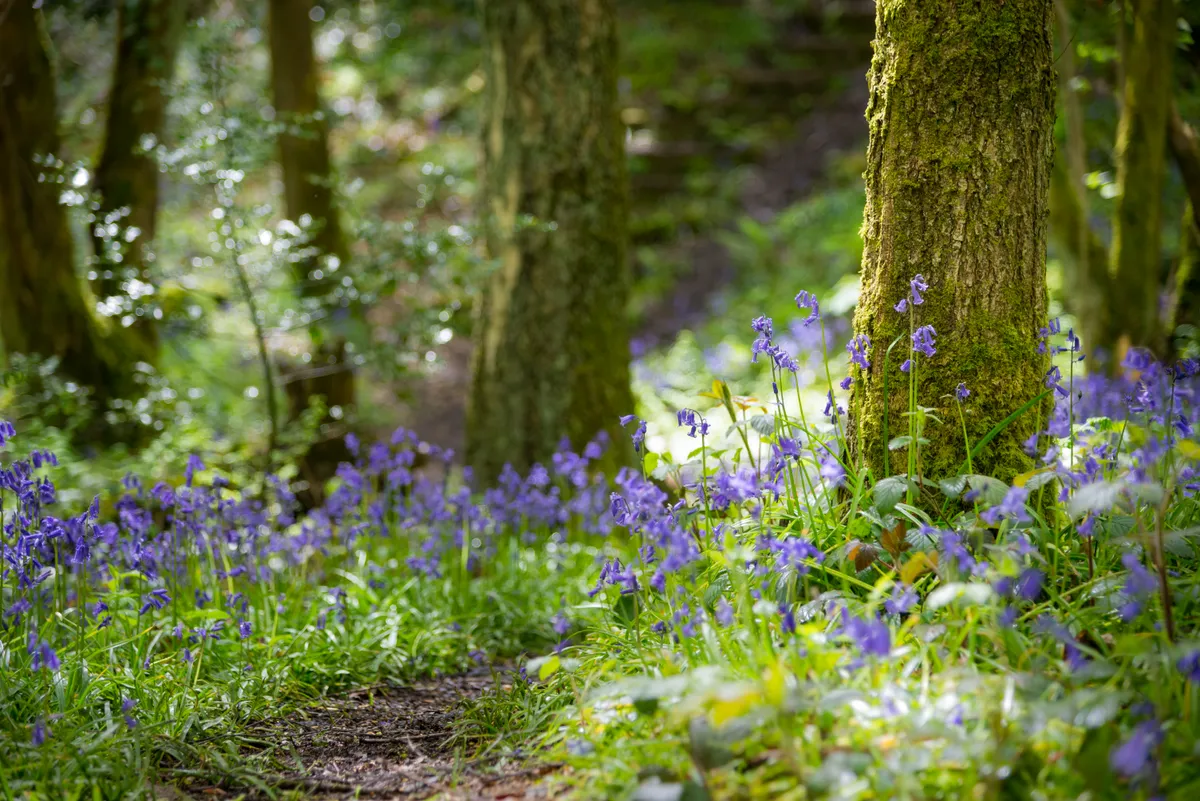
In woodlands across the UK, from Essex’s Epping Forest to Galloway Forest Park in Scotland, you’ll find plenty of moss. But while it may look very ordinary, researchers have discovered an ingenious purpose for it: solving crime.
Mosses (along with liverworts and hornworts) are a type of bryophyte, which are some of the simplest yet most ancient plants on Earth, lacking true stems, leaves, roots or seeds.
- Weird and wonderful winter woodland mysteries: find these odd natural phenomena on your next walk
- How tiny, overlooked, hornworts hold the keys behind plants' epic shift from living in water to smothering the land
- Unveiling our ancient woodlands: Just how old are they and what makes them so remarkable?
- How can you spot an ancient woodland?
Despite their biological simplicity, mosses are particularly sensitive and only thrive in very specific conditions and habitats. Different types of smaller organisms can even live on these mosses.
In 2024, Jenna Merkel, a master’s degree student at George Washington University, USA, began an internship with Matt von Konrat, head of botanical collections at the Field Museum in Chicago, USA.
“I thought, why don’t we look into writing a review of how bryophytes have been used in forensics?” says von Konrat.
With their results now published in the journal Forensic Sciences Research, the team examined 150 years of scientific literature to see how often mosses appeared in criminal investigations.
- Which plants existed in prehistoric times?
- Weirdest trees in the world: Discover nature's wackiest - including a deadly exploding one that's named the 'dynamite tree'
Forensic botany
The earliest case they found dated back to 1929 in Tyrol, Austria, where moss growth on a decomposing skeleton helped investigators estimate how long the individual had been dead.
The scientists found a further 10 cases across the USA, China, Finland, Sweden and Italy where bryophytes contained clues that helped answer the timing, location or circumstances of a crime.
Using moss in this way is an example of forensic botany, which is when plants are used in forensic investigations.
The team’s paper also includes the first detailed account of a case von Konrat and several co-authors worked on.

In 2011, a baby girl was killed by her father but her body wasn’t immediately located. The father only provided scant details of where he had buried her in northern Michigan.
Investigators had discovered microscopic plant fragments on his shoes, so von Konrat led a team of botanists and volunteers to survey the region, cataloguing grasses, trees and mosses in the hope that some of them matched the fragments.
“There are hundreds of species of moss and dozens of species of grasses and trees living in that area,” says von Konrat.
“But based on the bits of moss, we knew what sort of micro-habitat we were looking for.”
Using this method meant that the team could narrow the search from seven counties to an area of roughly 50 square feet. The location was later corroborated by the father in a further police interview.
The researchers hope that their findings will encourage a greater use of bryophytes as forensic evidence in criminal investigations.
And at the very least, their work will make you see woodlands, and the incredible plants they contain, in an entirely different way.