
It's the dead of night during an exceptionally cold spring in 1916 France, and the Allied troops are suffering after over a year at the front. Instead of benefitting from a few hours' kip, a group of soldiers is slowly but surely cutting down a tree in No Man's Land to the cacophony of artillery fire. Why would they put themselves in such peril? This tree could be the solution to a much-needed tactical advantage – let us explain...
The Western Front, a 400-mile stretch running through France and Belgium to the North Sea, was the decisive front during World War I (WWI) – whoever triumphed here would win the war. The only sign of life in this stretch of muddied trenches and desolate No Man's Land was the odd tree, which had stood for centuries before the conflict and should stand for centuries after. That would have been the case, but the newly-formed Special Works Park had other plans.
What were stealth trees?
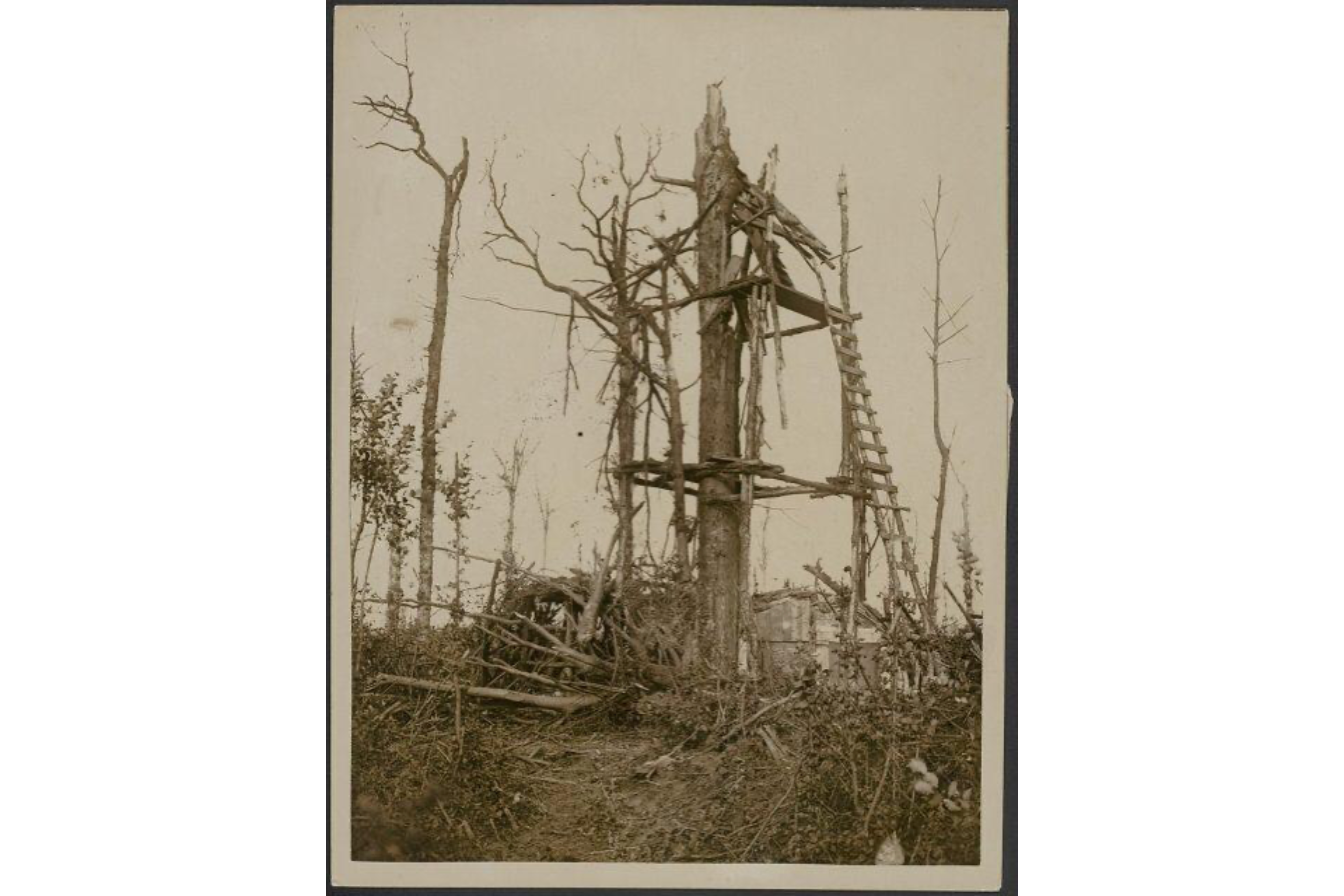
As WWI ramped up and soldiers started occupying the front, warfare was close at hand, and stalemates became more and more frequent. Armies had to become innovative to get the upper hand. The opposing trenches were on average 50-250m apart, but in some instances they were as close as a mere 20m – this presented a unique opportunity for espionage.
Concealment and deception started playing an important tactical role in what was becoming known as "The Great War", and in 1915, it was the French who first created a dedicated camouflage unit. The word itself comes from the French verb 'camoufler', originally meaning to disguise something or someone for the stage. Allied forces became inventive with the use of fake guns, hollow tanks, and even cloth railway lines, all intended to feed incorrect information to the opposition.
Since information was key to understanding the opposing threat, a key method to gather vital information was via surveillance from above. The soldiers needed a way to see without being seen themselves. But how? Then, French forces had a daring yet genius idea.
Planted in the dead of night, a stealth tree, also called "iron tree" by the soldiers, was a fake piece of shrubbery with an observation pole inside. Each camouflaged tree was crafted to look identical to the specific tree that had stood in the same spot moments before – this was key. The hollow replica of the real tree was expertly crafted so that enemy soldiers would notice no difference in the tree from one day to another. It was a mammoth undertaking, and the stakes were high.
The British army created a new unit, innocuously titled the Special Works Park (part of the Royal Engineers), which became the very first team to work on military camouflage. This formation enlisted various artists and craftsmen to conceptualise daring ideas like the stealth tree and one of the unit's leaders, who played a hand in the construction of the very first was artist, Solomon J. Solomon.
How were stealth trees made?
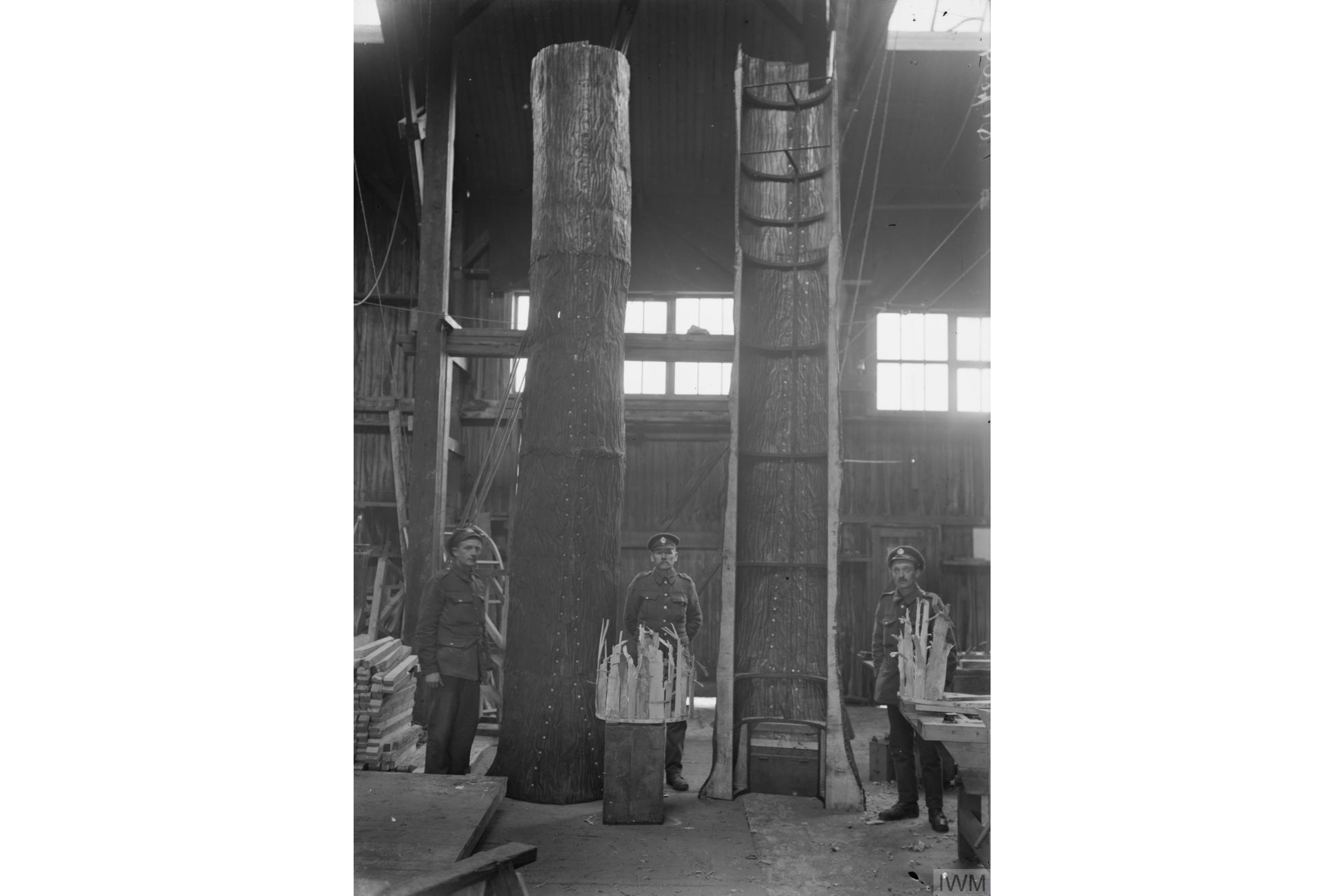
The fake tree needed to look identical to the original and artists like Solomon were transported to the front for the sole purpose of sketching the assigned tree as accurately as possible. This was done during the few hours of early dawn light. Once an accurate sketch had been obtained, the next step was to craft small model trees, and it was from these mini replicas that the full-scale trees were built and transported to the Special Works Park.
Construction of the stealth tree began with a hollowed-out steel cylinder frame that was joined together in sections until it reached the height of the original tree. Pasted over the top of this was a painted canvas sheet, with smaller details like textured real bark, tree knots, and hollows, intended to match the characteristics of the original in the most minute detail. The camouflaged trees could sometimes remain in position for months and even years at a time, so they needed to be solid and well-made to avoid detection. Once on the battlefield, any repairs would have been risky and complicated to carry out.
Once the tree replica was made, the real work began – how could the soldiers install the tree while in the line of enemy fire?
The stealth tree had to be installed at night. This involved the original tree being cut down and swapped out. Easier said than done! The dark would have made this particularly difficult to accomplish, and noise was unfortunately inevitable. The sound of tree demolition was typically covered up by some well-timed Allied artillery fire.
Once inside the camouflaged tree, a soldier would climb the narrow trunk to the best vantage point via a metal ladder or foot holes, from which they could observe and gain useful information on the enemy. To aid in this task, some stealth trees would have housed periscopes (like a hidden telescope), telephones, and weapons.
What size were stealth trees?
Stealth trees were designed to be the exact height and width of the real, original tree . Since only robust trees would remain standing in the midst of warfare, the stealth trees would have been at least thick enough to house a lone soldier and 6-12 meters tall to provide a height advantage for observation.
Who hid in stealth trees and how effective were they?
Soldiers deployed to the front would have used the trees as lookout and surveillance points to spy on the opposition. Space inside was typically cramped and narrow, they would have been uncomfortable to occupy for any significant period of time. Their utility likely varied based on location, height, and proximity to the enemy. They were also time-consuming and risky to install and once discovered, they were quickly targeted by enemy artillery or snipers.
Based on the fact that there was only a reported 45 trees are known to have been deployed by the British (six of which were destroyed by enemy shell fire), IWM Curator Sarah Paterson surmises that the tree may have been better as an abstract concept than a real one.
Famous examples of WWI stealth trees
The very first camouflaged tree was built in March 1916 and made to resemble a pollarded willow tree. A trip to the First World War Galleries at London's Imperial War Museum will lead you to one of the few known remaining stealth trees, which was recovered from the battlefield shortly after the end of WWI in 1918. Find out more information here.
Did both sides of the war use stealth trees?
The Germans also used disguised observation posts, including tree-like structures However, they tended to rely more on concrete bunkers, periscopes, and well-fortified observation points. The French and British were more known for using camouflage trees.
Use of stealth trees in other conflicts
The classic hollow camouflage tree remained mostly a WWI phenomenon, but the idea behind it lived on. Most conflicts after WWI were more mobile than the static trenches, so stealth trees would have been far less useful. Camouflage netting, ghillie suits and terrain blending allowed soldiers to blend in with their environment while being able to move and react to the conflict around them. Nevertheless, camouflage went on to play an important role in WWII later in 1939.
Sources: The Imperial War Museum and IWM Curator, Sarah Paterson.
Related content:
- Animal war heroes: 10 incredibly brave creatures that served alongside alongside us in times of war and conflict
- RNLI lifeboats launched 1,808 times and saved 5,332 lives at sea during the First World War
- Why are some places more 'thankful' than others? Discover the shameful secret behind the villages with no war memorial
- Best WWII movies of all time: 28 films that depict the horror and humanity of war

