I’m sitting in the sun, my head resting against the stones of an Iron Age roundhouse. Its walls encircle me, sheltering me from the wind and offering a view through its entrance across the vibrant heather, foxgloves and gorse of the moors to the sea beyond.
On the wind, I hear laughter and voices, yet there’s no-one else here; all is silent, except for the skylarks calling. Yet as I sit here, a strong feeling of place, community and people fills me, an embracing acceptance emanating from the ancient village itself.
- Discover Poldark's Cornwall
- Celebrate St Piran's Day: when it is and the legend behind the Cornish saint
Cornwall's ancient sites
This quiet moment, leaning against the timeworn, ancient ruin of Carn Euny (of which more later), sums up the way history pervades this part of the world. West Penwith – the far south-western peninsula of Cornwall – literally resonates with its past. You can walk its coast path or stride out across its moorland peaks and everywhere around you are remnants of our ancestors. Ancient places, buzzing with the memories of other lives lived, other powers worshipped.
Surrounded by the sea on three sides, West Penwith feels like an island. Its westerly position ensures it benefits from comparatively warm winds and waters year-round, while it also bears the brunt of the harsh westerly Atlantic storms.
A hotspot of prehistory
Geologically, it’s a landscape formed by granite forced upwards by tectonic movement through softer sedimentary rocks. The strength and porosity of granite created the high peaks of the moors and the soaring cliff faces of the coastline, while enabling the rich mineral deposits and resultant mining bounty. Historically, it’s a vitally important landscape, with more than 700 prehistoric sites – the highest density of ancient sites in Europe.
West Penwith is now a magnet for surfers and holidaymakers, with endless ocean swells, sheltered sandy bays, pasties, campsites and ice-cream-stealing seagulls. For locals, it’s a land of farmers, fishermen and creative folk; everything connected to, reflecting or coming from the dramatic landscape and the plentiful sea, as it has done here for millennia. Taking a step away from the coastal hotspots to the captivating historical sites can lure you into the mysterious ancient stories of this land.

It’s always made sense to me to explore a landscape chronologically as well as geographically. Roughly 6,000 years ago in the Neolithic Age, much of the land here was dense woodland with a warmer climate. The population was just a few hundred people, most of them related. The towering granite tors (rocky hills, known as ‘carns’ in Cornish) and coastal headlands were the most prominent features above tree level, which would have served as signposts, viewpoints and special places where people would gather.
Neolithic people used megaliths or stones to mark these significant sites. Of these, Carn Galver is believed to be the most important early prehistoric monument in the area.

Carn Galver is a twin-peaked, dragon-shaped carn that sits in the centre of the upland, northern area of West Penwith, where the largest Neolithic settlements were found. It would have been easy to spot from across the region, as it is today; the views from here are extraordinary.
It’s not thought that people lived permanently on Carn Galver, more that it was an important meeting point and served as a central trading spot for commodities. It’s a ‘tor enclosure’ – a structure with clearly positioned protective stone ramparts that enhanced the natural fortifications of the steep granite tor.
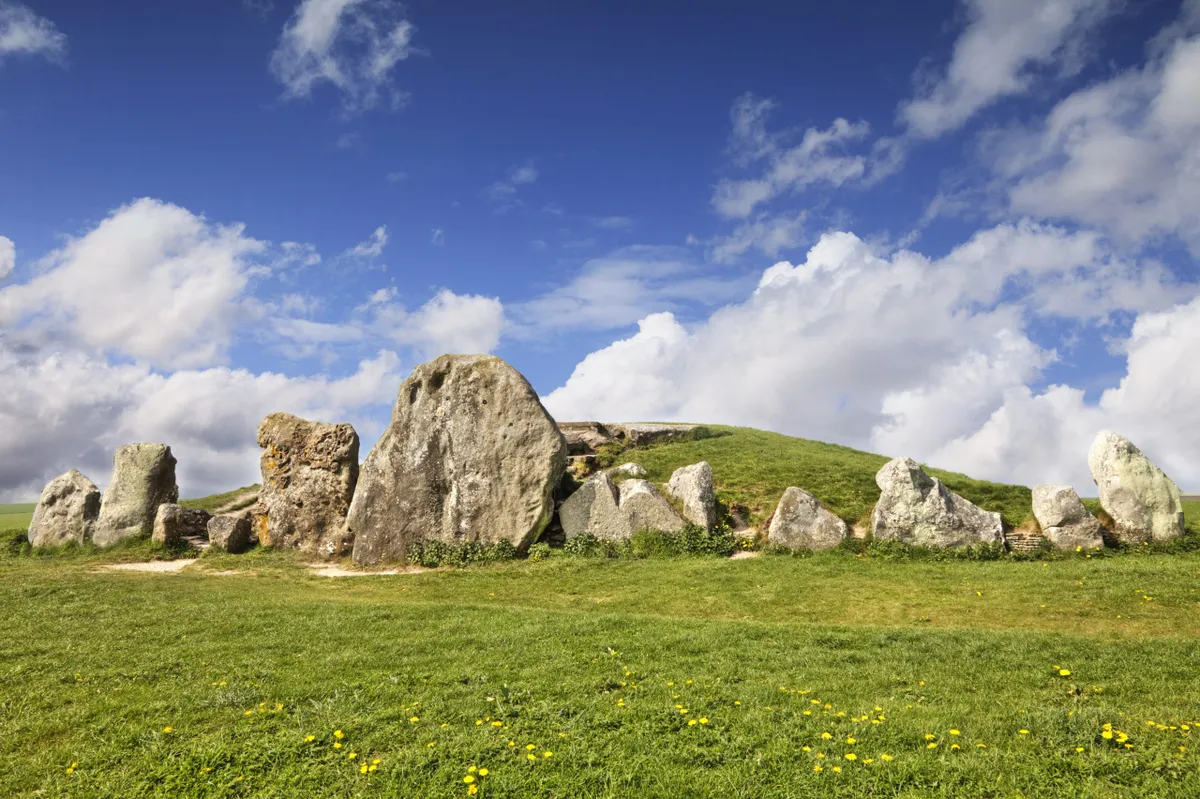
Of the Neolithic structures, ‘quoits’ are particularly prevalent in West Penwith; the most well-preserved of these, in the most spectacular location, is Chûn Quoit. These megalithic structures, known as portal dolmen outside of Cornwall, consist of several vertical stones supporting a vast flat capstone, which forms a small chamber underneath. Historians believe these structures were used as ossuaries – sacred places where ancestral bones were kept and ritual burial offerings made. While these were originally Neolithic structures, Bronze Age communities continued to use them to store talismans and cremated remains in burial urns.
By the Bronze Age, communities had formed settlements, with farming, mining and metalwork the main occupations. Ritualistic monuments were built, including stone circles – believed to have been important ceremonial and astronomical sites, tracking and celebrating the path of the moon and sun. Of the many in West Penwith, Boscawen-ûn is the most extraordinary.
It features 19 stones, one of which is made of pure white quartz, considered sacred by bygone builders. Thought to reflect the Metonic cycle of the moon and sun, it has a central stone that faces in the direction of the midsummer solstice sunrise. When the solstice sun shines on one of the circle’s outlying stones, it illuminates a carving of two axe heads at its base, a talismanic symbol.
No guide to the Bronze Age sites of West Penwith would be complete without a mention of the renowned holed stone of the Mên-an-Tol. Thought to have been the significant Neolithic part of a much larger stone circle created in the Bronze Age, the Mên-an-Tol is one of the best-known ancient monuments in the area. Powerful in its folkloric magic, its original function and importance is still the subject of ongoing debate.
Iron Age maritime trading
By the Iron Age, the Celtic population in West Penwith was well established. With its long coastline and plentiful land, fishing, farming and maritime trading were the hubs of this outward-looking civilisation. The area offered trading opportunities and a storm sanctuary for travelling sailors and the Celts here were well-connected, exposed to visitors and influences from far and wide, which only enhanced their strong cultural identity. In 60BC, the Greek traveller Pytheas visited West Penwith and his descriptions of the area led to the historian Diodorus Siculus aptly naming this peninsula Belerion, which means ‘shining land’ or ‘seat of storms’.
Carn Euny, one of the best-preserved ancient villages in south-western England, offers a captivating insight into how the Celts lived. The roundhouse foundations and later courtyard houses are the remains of a settlement that was occupied from the Iron Age until late Roman times.
The history is palpable, as if the inhabitants have only just left, particularly if you enter the mysterious underground fogou. In the centre of the village, this stone-walled underground passage is unique to the far west of Cornwall and archaeologists are unsure of its exact purpose. Many suggest that fogou were used for food storage, as a healing retreat or for spiritual rites. Either way, they are wondrously atmospheric.
Look beneath the surface
Tin and copper have been mined in Cornwall since the Bronze Age, and a visit to an abandoned mine can give you a real understanding of both the geology of this area and the cultural impact that mining had on generations of Cornish families.
Walking along the Tin Coast at Botallack – a mining site from the Bronze Age until 1895 – highlights the perilous cliff-side locations of seabed mines. Botallack Mine was a filming location for the BBC’s Poldark series; visiting on a stormy day among swirling sea mist, deafening gales and pounding swell evokes echoes of the accompanying manmade noise that would have been a constant here for thousands of years.

The south coast is gentler, more of a seafaring enclave and home to the iconic St Michael’s Mount. This ever-present coastal landmark tracks back through the annals of time, from its beginnings as a Neolithic tor enclosure when it was simply a tall hill in a woodland, to its role as a mythical island, cut off in the high-tide bay, peppered with stories of giants and angels. It was an important site for the ancient tin trade and a base for foreign explorers, a monastery, a village, a family home, and now an impressive National Trust property and whimsical backdrop to a delightful Cornish cream tea.
Cornwall’s maritime culture is a symbol of the county’s more recent history, and West Penwith is synonymous with piracy and smuggling, from the numerous smugglers’ caves spread along the south coast to the legend of the self-proclaimed Cornish ‘King of Prussia’ himself, John Carter. A visit to Prussia Cove, a collective name for four adjacent well-hidden coves in Mounts Bay, will leave you in no doubt as to how geography was a crucial player in this area’s smuggling successes.
Between 1770 and 1807, John Carter and his brothers ran two, fully crewed large boats that would sail from these secluded coves across to the continent to collect wine, tea, tobacco and spirits, then whisk them back to Cornwall. From there, they were sold – without import duty – to local people and businesses. Revered locally, the brothers were protected by their fellow Cornishmen to the end, only disappearing from the scene when smuggling was stamped out in the early 1800s.
West Penwith is a unique place to explore, full of fascinating legends and stories tantalisingly brought to life by relics and remnants strewn across its moors and coasts. There’s always a tale to be told, history to learn or a mystery to unravel. Adventures here, far from the madding crowds, offer unparalleled opportunities to lose yourself in the past and follow truly ancient footprints across this land.
Discover more walking trails in Cornwall