When you think of non-native species in the UK, you might think of grey squirrels, American mink or even muntjac deer. But while they often cause their own form of chaos, there are other alien species that are a little more surprising...
- Britain's most endangered animal species: Discover the rarest creatures in the UK
- From dam-building beavers to soaring white-tailed eagles, meet the 'lost' animals that have been successfully reintroduced to Britain
Non-native species in the UK
Yellow-tailed scorpion

Among more than 80 million objects held by The Museum of Natural History in London is a European yellow-tailed scorpion, collected by entomologist James John Walker from Sheerness, in Kent in 1870. The scorpion was found at the Naval dockyard and remains the earliest official record of a colony that has scuttled ever since.
Native to North Africa and Southern Europe, it was from Italy that the yellow-tailed scorpions of Sheerness are believed to have originated, having become unwitting stowaways in shipments of masonry. They are not large, with a body length of only 3 or 4cm, while the juveniles are only millimetres long.
As nocturnal ambush predators, the scorpions are easily overlooked as they tuck away waiting for dinner to deliver itself. Woodlice are a common prey, while in the 4 metre dock walls at Sheerness they eat, and are eaten by, other non-native species, particularly the tube-web spider and noble false widow.
The yellow-tailed scorpion has been established in the British Isles for longer than familiar non-native species such as grey squirrel and little owl, having found a niche of little impact on native wildlife or threat to people. The sting, while functional, is said to be less painful than a bee or wasp and they are reluctant to use it at all.
The yellow-tailed scorpion is likely more widespread than we realise, with known populations at the ports of Southampton, Plymouth, Portsmouth, Tilbury and Harwich, an inching expansion across east London, and recent sightings in Stow-on-the-Wold and Swansea University.
Green lizard

The cliffs at Boscombe, to the east of Bournemouth on the Dorset coast, may seem an unlikely place for a non-native species to thrive. Yet on a warm day, as thousands of holidaymakers fill the beach below, green lizards measuring more than 30cm long will be soaking up the sun on the slopes above.
The green lizard is normally found from northern Spain across to the Black Sea coast in the east, with a geographical split between western and eastern variants occurring around the borders of Austria, Italy and Slovenia. Several attempts have been made to introduce them to the British Isles, but their survival has been short-lived, mainly due to the colder climate.
As their name suggest, they are largely green in colour, with blue around the throat and face which is stronger in the males. The Boscombe lizards appeared following one or more unauthorised releases, but debate continues as to when.
For more than 30 years they have snuck beneath the gorse and behind beach huts, where they share the scrubby, southern outlook with common lizards and non-native wall lizards. Similar in size and appearance to common lizard, the wall lizard is becoming increasingly widespread, its future seemingly secured.
The green lizard might also survive in the long-term, but there is concern that it may impact native sand lizard populations. They will prey on smaller lizard species, but more likely they would dominate shared habitat and the smaller sand lizards would diminish.
Red-necked wallaby

Interest in the natural world grew steadily during the 19th century – ecologically, agriculturally and simple curiosity – with animals displayed as exhibits in zoos or private parks. As international knowledge grew, so Acclimatisation Societies were created with the purpose of moving species to new locations, across countries and continents, to judge their adaptability and potential human benefits. As a result, familiar European species such as the rabbit and blackbird can now be found in Australia, while red-necked wallabies were among many animals brought to the British Isles.
Red-necked wallabies are native to south-east Australia and Tasmania, where the climate is similar to the UK. First Nation people used wallaby skin to make clothing, shoes and water carriers, while the meat was also held in high regard.
Wallabies have a deserved reputation as escapologists, and captive animals have often bounded into the wild and formed small breeding colonies. The most famous of these was in the Peak District, where a small group appeared in the 1940’s and remained for around 60 years.
Similar populations have occurred in Sussex, Berkshire, Somerset and the East Midlands, with a colony also on Inchconnachan, an island in Loch Lomond. The largest population live on the Isle of Man, where around 1000 of these metre-tall marsupials now live, sufficient number, perhaps, to survive indefinitely. Their plant-based diet may cause issue, particularly for arable farmers but also gardeners. Wallabies are often spotted in private gardens where they might enjoy the variety of food a little too much.
- This odd kangaroo-like animal is native to Australia – but it's been spotted roaming wild on a Scottish island
- “No one wants to use the word ‘cull’”. There’s an island off the UK overrun with wallabies – and they’re causing chaos
Wild boar

Wild boar were once widespread in the British Isles, thriving in the great Neolithic forests when some 80% of the land mass was covered in trees. They were an animal revered, with boar imagery decorating the armour of Celts and Anglo-Saxons, and the emblematic banners of medieval kings Henry II, Edward III and Richard III.
Deforestation and hunting saw them disappear from these islands by the 14th century, although sightings were made, possibly following introductions from Europe, until the 18th century. In the latter part of the 20th century, wild boar meat enjoyed something of a culinary renaissance, and farms began keeping them as livestock. This led to escapes, and in some areas they colonised.
The Great Storm of 1987 saw a small number of boar escape from a farm in Kent, and a population remains on private land on the Sussex/Kent border. Around 50 animals became established in West Dorset in the 1990’s, but they have been eradicated with no confirmed sightings for several years.
The largest population occurs in the Forest of Dean, where much of the land is owned by Forestry England. As escapees, wild boar are considered feral, and their fate determined by the owners of the land on which they occur. Following public consultation, Forestry England have opted to manage numbers to a ceiling of 400 individuals.
While boar, mainly through rooting of the earth, can cause localised damage, the same behaviour can benefit the habitat, helping to reduce dominant plant species like bracken and creating watery wallows where invertebrates may thrive.
Aesculapian snake

In the 3rd century BC, a delegation of Roman Elders sailed to Epidaurus in Greece to visit the Sanctuary of Asclepius. A plague was devasting Rome, and in desperation they sought to secure a statue of the God of Healing, Asclepius - known as Aesculapius in Roman.
Instead, on arrival, a snake slithered onto their ship. Taking that as a positive omen, they returned to Rome and built a temple in the spot where the snake subsequently disembarked. The plague abated, and the snake was subsequently heralded. As a result, these snakes were distributed across the Roman Empire, being released in temples where they might bring blessings of health and medicine.
It is possible that Aesculapian snakes were brought to the British Isles during the Roman occupation, but the two populations that exist today have more recent origins. Escapes from the Welsh Mountain Zoo has seen the establishment of a colony in Colwyn Bay where snakes, which are harmless to humans, seek shelter and safe hibernation in lofts and wall cavities.
The origin of the snakes that live in London, particularly Camden and Regent’s Park, is less certain, but sightings have been made for nearly 50 years. They are capable of reaching two metres in length and feed primarily on rodents.
Their future is uncertain, not least due to inbreeding depression, which will likely occur without fresh genetic intervention. The snakes will long survive as emblems, however. The Staff of Aesculapius, entwined with a snake, is the symbol of at least 80 health organisations worldwide.
Kellas cat
For generations there have been tales of big, black cats stalking the Scottish glens, animals as big as dogs that would snatch sheep or attack cattle. In Scottish folklore stories are told of the Cat Sìth, a mysterious black cat with a distinctive white spot on its chest that could walk on its hind legs and even talk.
The legend was rooted in Celtic culture and in the 1980’s came a curious connection. A black cat was trapped near the Moray village of Kellas, and while not ‘dog-size’ it was considerably larger than a domestic cat. Studies showed it to be a hybrid of a feral cat and Scottish wildcat, and further specimens were collected. All shared similar characteristics, including a distinct white patch on the chest, reminiscent of the Cat Sìth, though none were considered of a size capable of threatening large livestock.
In recent years though, reports made to Paul MacDonald of the Scottish Big Cat Research Team, suggest these feral cats are getting bigger and more widespread. A couple of cats ‘big enough to trouble a sheep’ have been the victims of road traffic collisions, while the skeletal remains of a specimen found near Bannockburn suggested a body length of 120cm and a skull the size of an Easter egg.
Unfortunately, the presence of any feral cats will further hinder the survival of the native Scottish wildcat, through competition and inter-breeding. Attempts to save the wildcat are at a critical point with the species’ survival deemed no longer viable without human intervention.
Ring-necked parakeet

So familiar is the emerald flash and jarring shriek of the rose-ringed parakeet in parts of the south-east that it is hard to imagine a landscape without them. They remain oddly exotic though, with long tails, bright red beak and pink-flushed neck ring that gives them the alternative name ‘rose-ringed’.
Equally colourful are some of the stories as to their source, although theories that they escaped the set of The African Queen or descended from birds released by Jimi Hendrix have little substance. They have been popular pets since the time of Ancient Greece, with escaped birds recorded in Britain since the mid-19th century. It wasn’t until the 1970’s that they became truly established, with colonies appearing in suburban Surrey and Kent.
Since the 1990’s, numbers have exploded, and their range expanded. Today, the repeated squawk, not unlike the sound of a dog chew toy, can be heard from the parks of Plymouth to Edinburgh, and they are familiar visitors to bird-tables – especially in winter.
- Ring-necked parakeet guide: what they look like, what they eat and where to see them
- Exotic parrots are spreading across Britain: are ring-necked parakeets welcome visitors or a potential problem?
The UK climate might seem unsuitable for an equatorial native, but in their natural range, ring-necked parakeets are found in the cool air of the Himalayan foothills and have established feral populations in several European countries. In Seville in Spain, greater noctule bats have declined dramatically following attacks by parakeets and calls for control are loudening there and elsewhere. Their impact in the UK is a concern for many, but one beneficiary is the peregrine falcon which has increased in urban areas and is particularly partial to parakeet.
Eurasian eagle owl

We have two non-native owl species breeding in the British Isles, and the contrast between them could not be much greater. The little owl, no bigger than a mistle thrush, was introduced in the late 19th century and found itself a niche. Too small to trouble game or poultry, it gained a talon-hold across much of lowland England, although it is now in steep decline.
The Eurasian eagle owl, meanwhile, is huge, with a 2-metre wingspan and the power to prey upon animals as large as a fox. They were once a native species, but there is no definitive proof that they have occurred naturally in the British Isles since the start of the Holocene Period. There are those that dispute this, believing that despite its size, their shy, nocturnal nature has enabled small numbers to survive unseen.
Eagle owls are popularly kept in captivity, and it is escaped birds that are believed to have begun the scatter of known breeding instances over the last 40 years. Some pairs, such as in North Yorkshire and the Forest of Bowland, have been prolific, fledging multiple young, but unless a bird can be proven to have arrived from a wild population elsewhere they will remain unprotected.
A conflict of interest comes from their potential impact on other species. Eagle owls will prey on hedgehogs and other raptors, and the remains of a hen harrier were found close to an eagle owl nest in Bowland which caused added concern for a bird whose plight is already contentious.
Signal crayfish
We might excuse some historical introductions due to naivety. Our understanding of natural history was thin in the 19th century, with Darwin’s evolutionary theories controversial, and as a result, potential impact of species such as the grey squirrel or muntjac upon our native fauna and flora was overlooked.
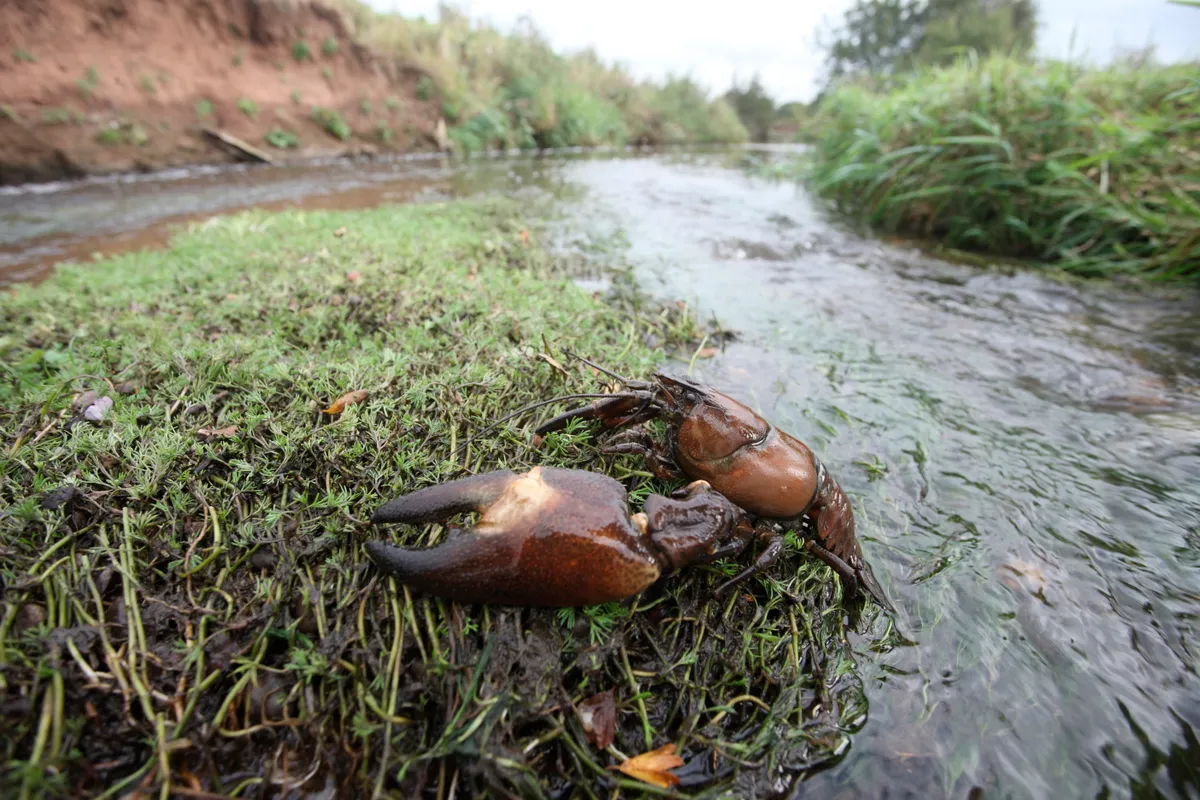
By the 1970’s however, we really ought to have known better, but the introduction of the signal crayfish from North America, as a readily available and easily managed food source, has created problems too complex to solve. They are unfussy eaters, feeding on invertebrates, fish eggs, and small fish. In some smaller habitats they are so prolific as to have all but created a monoculture, surviving through cannibalisation.
They burrow into soft banks, causing erosion and colouring the water, which in turn reduces light levels and weed growth. They also carry a crayfish plague, a type of water mould, to which they are immune but our native, white-clawed crayfish has no resistance. The subsequent decline of white-claws has been extreme, and they are now considered endangered.
A further problem is the similarity between both species, especially when young. Both have a small, lobster-like form, with the bright red and turquoise on the claws giving the signal crayfish its name. The shape of the rostrum (the nose-like tip of the head) is the most reliable diagnostic feature, although the signals will grow larger, measuring up to 30cm long.
Signal crayfish are widespread and here to stay, a truly invasive species.
Wels catfish

For many years, anglers fishing the lower reaches of the River Thames have reported the loss of enormous fish, particularly at night. It is a pattern familiar on other rivers, like the Severn and Trent, and the unstoppable culprits are almost certainly wels catfish.
The wels is a freshwater giant, often growing in excess of three metres in length and rumoured to reach five metres and 275kg (600lb) in weight in the Volga River system in Ukraine and Russia.
Native to central-eastern Europe and parts of Asia, wels were introduced to rivers in western Europe from the mid-20th century for their sporting qualities. In some river systems, such as The Ebro in Spain, they have flourished, while the disappearance of many native fish species is unlikely to be a coincidence.
Wels are unfussy eaters, using their whiskers to search for food alive or dead. Cavernous mouths and long, slug-like bodies, enable them to swallow large items; remains of wild boar and deer have been found in larger specimens.
Wels were first brought to the UK in the late 19th century by Herbrand Russell who stocked them in a lake at his Woburn Abbey home. More recently, they have been stocked in an estimated 500 lakes nationwide, although this can only be done under licence. Those uncaught monsters in our river systems have either escaped or more likely been unofficially stocked. Their long-term impact in such places is uncertain, but they are certainly capable of breeding in British river systems and gaining gargantuan size.
Discover more wildlife from around the UK
- Hedgehog, squirrel and white peafowl – meet the albino animals found in Britain
- Raccoons, pink salmon and purple clams: these are the latest invasive threats to British wildlife, say experts
- Exotic – and sometimes deadly – animals that supposedly roam the British countryside, from big cats to raccoon dogs
- 10 strange animals that live secretly in your house