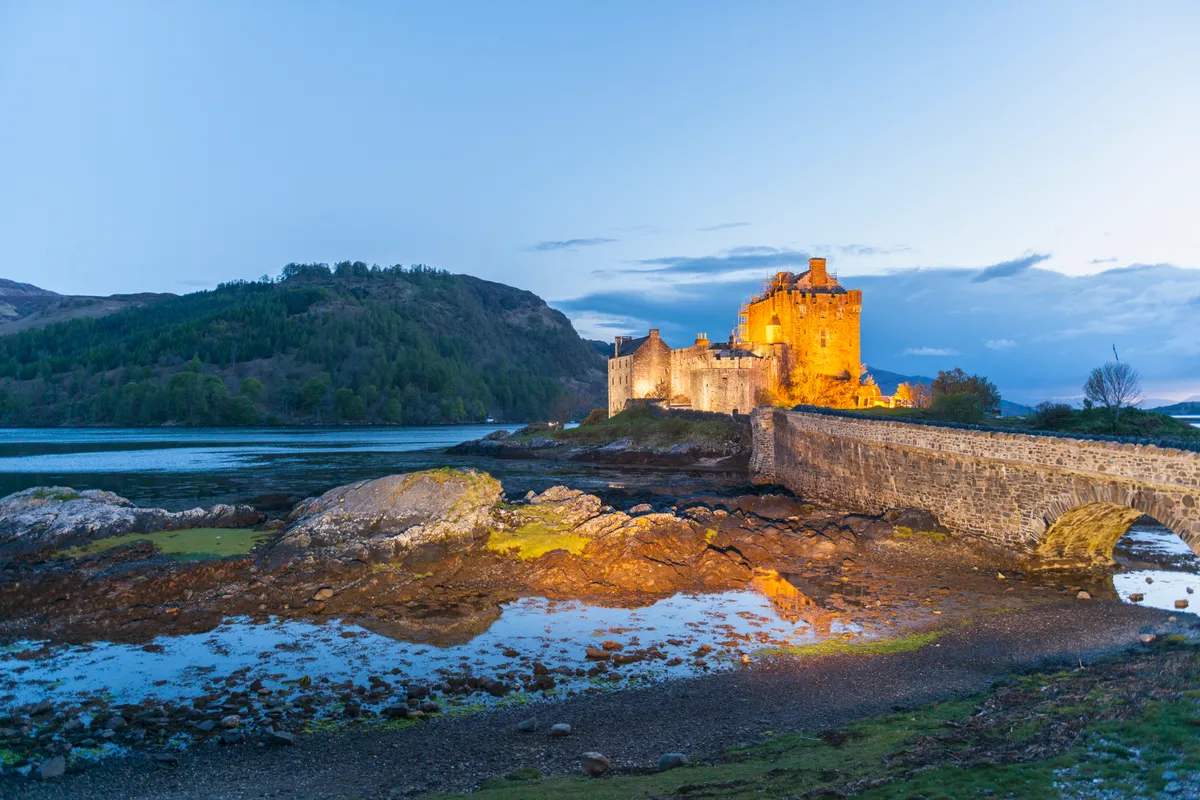
From Tolkein’s Middle Earth to Pullman’s Oxford, these incredible UK locations inspired writers to create masterpieces of fiction.
- Britain's best literary forests uncovered
- Great novels and autobiographies set in the British countryside
Literary landscapes in the UK
1. The Hobbit and The Lord of the Rings, JRR Tolkien

Fantasy author JRR Tolkien’s mythological Middle Earth takes inspiration from a number of places in Gloucestershire and the West Midlands. Tolkien frequently visited the Forest of Dean and its temperate rainforest Puzzlewood, which is said to have influenced his creation of tangled, mossy forests such as Mirkwood.
Tolkien’s fictional ents – strange, gnarled, tree-like creatures who protect the ancient woodlands – might also have their roots here.
The idyllic Shire, home of hobbit Bilbo Baggins, is reminiscent of the sleepy villages and gentle undulating hills around the verdant Vale of Evesham, where Tolkien visited his brother, Hilary, who had a pretty orchard of plum and pear trees. Today, an annual 55-mile, AA-signposted Blossom Trail blooms with colour in spring. Other nearby beauty spots appear in Tolkien’s work.
His illustration of the Doors of Durin – a hidden entrance to the mountain that harbours the dwarf city of Khazad-dûm – is almost identical to the north door of St Edward’s Church in the Cotswold town of Stow-on-the-Wold, which has vast trees each side of it that have merged with the stone over centuries.
The Malvern Hills, which Tolkien often visited in the 1930s, are said to have inspired Gondor. Here you can walk along the 14km ridge and enjoy stunning views from Worcestershire Beacon. Just keep your eyes peeled for sneaky hobbitses…
- Find the inspiration for The Lord of the Rings and the The Hobbit in the British countryside
- How a small, charming English town, set at the foot of beautiful hills, gave the world Narnia, hobbits, Middle Earth and Nimrod
2. A Game of Thrones, George RR Martin
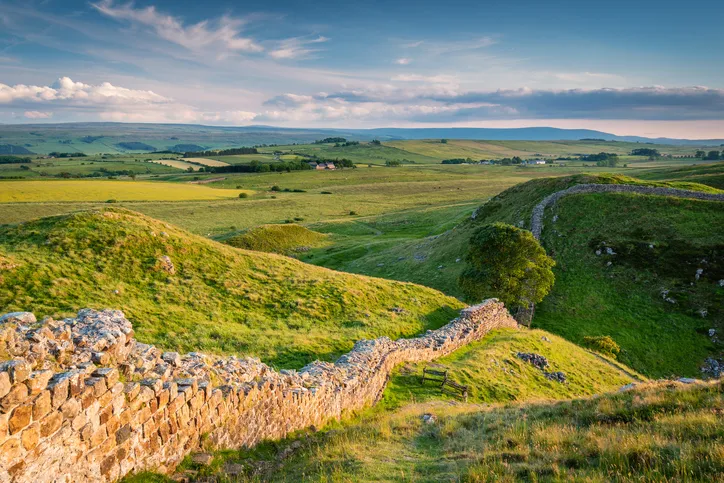
“The Wall sprang from my visit to Hadrian’s Wall in 1981,” wrote George RR Martin, American author of A Game of Thrones (1996).
This first novel in the fantasy series A Song of Ice and Fire became the basis for the hit HBO TV drama in 2011 (and later spin-off House of the Dragon).
Martin’s fictional wall is an ancient barrier of ice, stone and magic, hundreds of miles long, defended by the Night’s Watch. It protects the Seven Kingdoms from the dangerous northern wilderness, and the undead Others and human Wildlings who live north of the wall.
In reality, Hadrian’s Wall is a magnificent 73-mile, coast-to-coast structure built by Emperor Hadrian in the 2nd century CE to defend the north-west frontier of the Roman Empire.
It’s a UNESCO World Heritage Site and you can walk the length of it along the Hadrian’s Wall Path National Trail, which runs from Bowness-on-Solway in Cumbria to Wallsend, Newcastle-upon-Tyne.
- The best UK UNESCO World Heritage sites to visit for unforgettable days out
- Hadrian's Wall: where is it, when was it built, how long is it and best walks
3. The Lion, the Witch and the Wardrobe, CS Lewis

Born in East Belfast, CS Lewis holidayed on the north coast of County Antrim as a child. The beauty of the landscape moved him and influenced the setting of Narnia in his 1950 children’s fantasy novel The Lion, The Witch and The Wardrobe.
It is thought that Narnia’s capital, Cair Paravel, is based on the derelict cliff-top Dunluce Castle near Castlerock.
“The castle of Cair Paravel on its little hill towered up above them; before them were the sands, with rocks and little pools of salt water, and seaweed, and the smell of the sea and long miles of bluish-green waves breaking for ever and ever on the beach. And oh, the cry of the seagulls! Have you heard it? Can you remember?” he wrote in his classic story.
The romantic ruins of the present castle date from the 16th century and loom over the Atlantic Ocean, not far from the Giant’s Causeway. Visit the site and explore the Causeway Coast Area of Outstanding Natural Beauty, too – a stunning landscape of red sandstone, black basalt, grey clay and white limestone.
Irish legend, the Children of Lir, has roots in Antrim. In the tale, four children are turned into swans by their evil sorceress stepmother and spend 300 years on the Sea of Moyle, which stretches from the Antrim Coast to Scotland. This Celtic story shows how resilience and love can overcome the darkest of curses – and could well have influenced a young CS Lewis.
4. Pride and Prejudice, Jane Austen

“There is not a finer county in England than Derbyshire,” wrote Jane Austen in her 1813 classic Pride and Prejudice, which is heavily influenced by the pretty villages, grand estates and vast landscapes Austen admired in this region.
Austen is rumoured to have written her novel while staying in Bakewell, which is thought to have inspired the fictional town of Lambton. Mr Darcy’s imposing residence Pemberley was based on the stately home Chatsworth House; scenes for the 2005 film were shot there.
To see the lake where Colin Firth’s Mr Darcy emerged, famously, in a wet white shirt in the 1995 BBC adaptation, head to the National Trust’s Lyme Park Estate. Incidentally, that shirt auctioned for £25,000 last year. Presumably it has now dried out.
- Walk: Lyme Park, Cheshire
- This iconic stately home is holding a Regency festival to celebrate its literary connection
Pride and Prejudice has been adapted for the screen at least 17 times. It is currently being filmed for Netflix with Olivia Colman as Mrs Bennet, Emma Corrin as Elizabeth Bennet and Jack Lowden as Mr Darcy.
The Peak District’s untamed landscape reflects Elizabeth’s daring character and wild nature. On screen, rocky Peak District locations create dramatic scenes. In the 1995 BBC series, Elizabeth (Jennifer Ehle) climbs the outcrop Ramshaw Rocks, while in the 2005 film, Keira Knightley’s Elizabeth stands – windswept and moody – atop the four-mile-long gritstone ridge of Stanage Edge, looking to the vast Hope Valley beneath, her cape billowing.
- The dreamiest, most romantic British rural love stories on screen: Fall in love all over again with these classic British countryside romances
- The best Jane Austen quotes, one of our literary greats, that capture her sharp wit and humour
5. Harry Potter, JK Rowling

JK Rowling penned her early manuscripts in The Elephant House – a humble café on George IV Bridge in Edinburgh – and the city’s landscape influenced her writing.
Rowling took names for some characters from gravestones she spotted in Greyfriars Kirkyard (such as Robert Potter and Thomas Riddle) and the bustling Victoria Street inspired Diagon Alley.
While many scenes at Hogwarts were shot at Oxford’s Christchurch College, the likely inspiration for the magical school is Edinburgh’s gothic George Heriot’s School, with its turrets and austere architecture. To tread in Rowling’s footsteps, take a Harry Potter walking tour of the city.
From Edinburgh, head to the Highlands, where many scenes in the films were shot. Loch Sheil, Loch Morag and Loch Eilt appear as Hogwarts Lake, while Dumbledore’s grave on the Island of Trees is the small island Eilean na Moine on Loch Eilt. To ride Hogwarts Express, catch the Jacobite steam train over the Glenfinnan Viaduct.
- Where was Harry Potter filmed? Our guide to the Harry Potter film locations
- Where is the new Harry Potter TV series filmed? All the filming locations used in the magical wizarding world
6. The Tale of Peter Rabbit, Beatrix Potter

London-based children’s author and illustrator Beatrix Potter enjoyed summer holidays in the Lake District and was charmed by the beauty of the landscape there.
She stayed at Cumbrian country houses, such as Lingholm, which has a large kitchen garden that was the original inspiration for Mr McGregor’s garden in her first book, The Tale of Peter Rabbit.
- Beloved children's author, artist, scientist, sheep farmer – 10 things you didn't know about Beatrix Potter
- Matt Baker: Potter the lakes in pursuit of Beatrix
The proceeds from this popular story enabled her to buy her own Lakeland retreat – Hill Top, a pretty farmhouse near Sawrey in Ambleside – which she owned from 1905 until her death in 1943. This idyllic dwelling with its slate roof, cottage garden and unspoilt interior is now owned by the National Trust.
Visitors to Hill Top can spot glimpses of the house and garden in the charming illustrations in many of Potter’s little books, such as The Tale of Tom Kitten (1907) where it is the home of Tabitha Twitchit and her three mischievous kittens, Moppet, Mittens and Tom. You can even see the famous rhubarb patch in the garden which features in The Tale of Jemima Puddle-Duck.
Esthwaite Water is nearby, as is Claife Viewing Station on Windermere’s west shore, where you can enjoy lake vistas and a four-mile ambling trail.
7. Wuthering Heights, Emily Brontë

When Emily Brontë wrote her bleak gothic novel Wuthering Heights in 1847, she drew inspiration from long walks on the lonely moors above the village of Haworth in West Yorkshire, where she lived with her sisters Anne and Charlotte from 1820 to 1861.
Even the name of her tale references weather and landscape, and Brontë often conveys Heathcliff’s brooding mood via the cold, foggy moorland that surrounds him.
“My love for Heathcliff resembles the eternal rocks beneath,” his soulmate Cathy declares, likening her love for him to the gritstone outcrops in areas such as Ponden Kirk (renamed Penistone Crag in the novel) where the fated lovers meet.
Today, you can hike to Ponden Kirk from Haworth and visit the ruins of Top Withens, said to be the inspiration for the Wuthering Heights farmhouse. The Brontë Parsonage Museum is located at the former Brontë family home in Haworth, West Yorkshire.
Margot Robbie plays Cathy to Jacob Elordi’s Heathcliff in a film adaptation of the novel, due for release in February 2026.
- Explore the landscape that inspired the Brontë sisters
- Where is Wuthering Heights filmed? All the locations used in Emerald Fennell’s steamy adaption of the Gothic tale
8. His Dark Materials, Philip Pullman

Fantasy author Philip Pullman studied English at the University of Oxford’s Exeter College and was inspired by both the layout and location of his alma mater when he created the fictional Jordan College in the His Dark Materials trilogy.
Pullman’s imaginary Oxford in the parallel universe inhabited by young heroine Lyra Belacqua has many similarities to the real city – for example, the Bodleian Library (one of the most beautiful in the UK) is renamed Bodley’s Library and houses the alethiometer – a magical truth-telling instrument that allows Lyra to find answers to questions.
Oxford’s covered market is mentioned, too, and it is on unremarkable Sunderland Avenue, adjacent to the ring-road, that hero Will Parry finds his first window into another world. Proof, perhaps, that the magical may exist in the most mundane of places.
Other city attractions include Pitt Rivers Museum, where Lyra investigates the Tartar phenomenon of trepanned skulls in The Subtle Knife, and the lovely Oxford Botanic Garden, where Lyra and Will pledge to meet on a bench at noon every Midsummer’s Day.
Beyond the city, enjoy beautiful walks such as the Ridgeway, the Chilterns Way and the Thames Path.
9. Winnie-the-Pooh, AA Milne
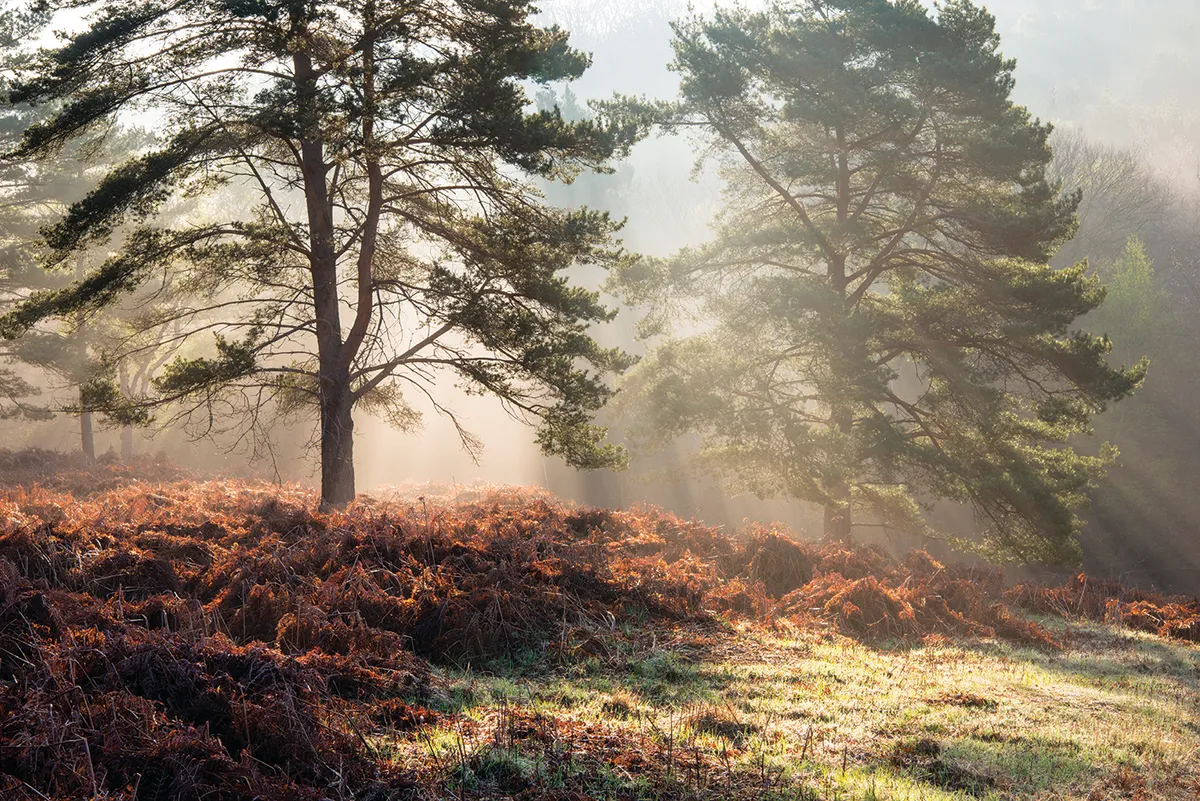
AA Milne lived at Cotchford Farm on the edge of Ashdown Forest in East Sussex and was inspired by adventures with his young son Christopher Robin – and his favourite teddy bear, Pooh – to write his much-loved Winnie-the-Pooh stories, which were illustrated beautifully by EH Shepard.
Milne’s “100 Aker Wood” is as unspoilt today as it was when he wrote his novel in 1926.
Many of the story’s locations can be visited on foot: a cluster of Scots pines inspired The Enchanted Place; a large conifer on a heath became the Heffalump Trap, where Pooh and Piglet tried to capture a terrifying creature; and a small sandstone quarry appears as Roo’s Sandy Pit.
The famous Poohsticks Bridge from Milne’s final book The House at Pooh Corner (1928) is real, too, although it has been restored over the years. Built in 1907, Posingford Bridge is half a mile from a handy car park on Chuck Hatch Lane.
The AA Milne and EH Shepard memorial at the lovely Gills Lap (called Galleons Lap in the stories) offers fabulous views from this beauty spot.
- Discover the real-life Winnie-The-Pooh locations that inspired the famous children's books by AA Milne
- Best Winnie the Pooh quotes: simple words that remind us of the importance of kindness, adventure and the beauty of being yourself
10. Dracula, Bram Stoker

A visit to the Yorkshire harbour town of Whitby in 1890 gave Irish author Bram Stoker atmospheric settings for his gothic horror novel, as well as the perfect name for his infamous vampire.
The ruin of Whitby Abbey towers over the town and is reached by 199 steps from the church of St Mary, where Stoker noted names from gravestones such as ‘Swales’ – which he later used for Dracula’s first victim.
Stoker went to Whitby public library and borrowed a book that referred to Vlad the Impaler, a 15th-century prince who was said to impale enemies on wooden stakes. He was known as Dracula, meaning ‘devil’ in Wallachian. Stoker took note.
Tales of Whitby shipwrecks (the Russian ship Dmitry ran aground below East Cliff five years before Stoker’s visit) inspired the start of the novel, in which a ship is wrecked at East Cliff and a large dog (Dracula!) leaps from the vessel before running up 199 steps to a church.
Whitby Abbey is open to visitors and hosts regular events. Whitby itself has much to offer, including whale watching trips, a Captain Cook memorial museum and beautiful sandy beaches. The North York Moors National Park is nearby, as is the picturesque fishing village of Robin Hood’s Bay.
- This monstrous hellhound is thought to have inspired Dracula – discover the legend of Barghest
- The most haunted places in Britain - including a fortress patrolled by a ghostly bear
Top image: A view of the derelict Top Withins Farm House on the North Yorkshire moors near Haworth, believed to be the setting for Emily Brontë's romantic novel 'Wuthering Heights'. Credit: Christopher Furlong/Getty Images