
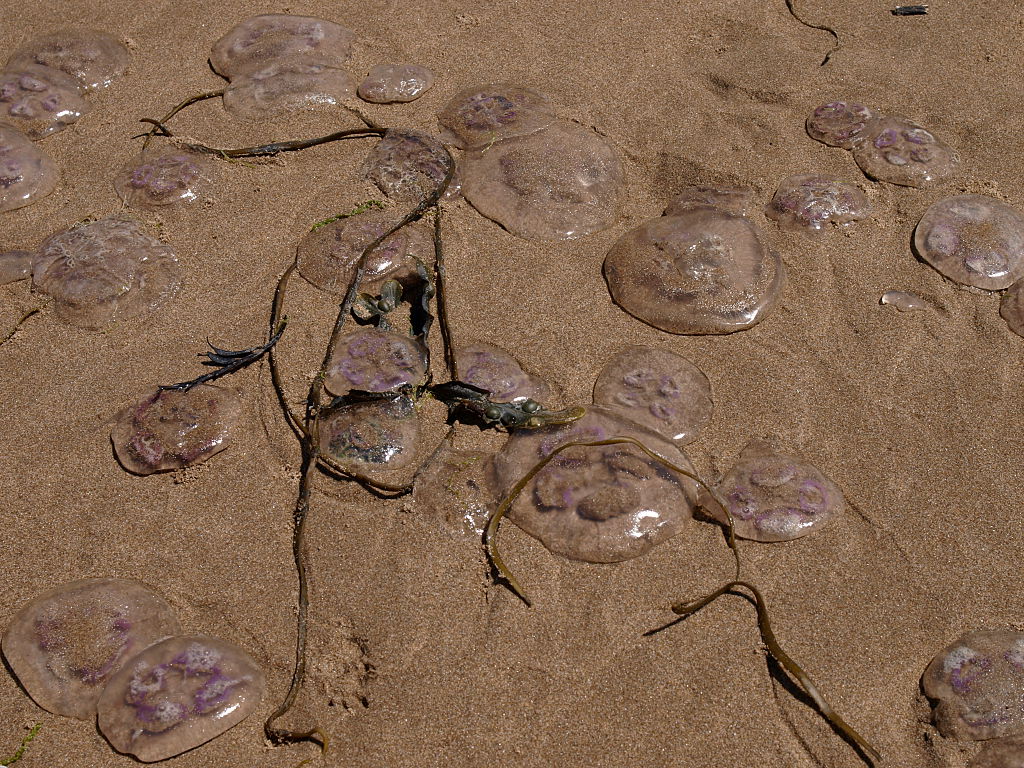
Beachgoers have been noticing an influx of jellyfish around the UK. Staff at Bude Sea Pool in North Cornwall cleared 16 wheelbarrows worth of jellyfish at the start of July, as the area around the tidal pool had become covered following high tide. The bloom mainly consisted of moon jellyfish, but there are also some blue jellyfish and mauve stingers.
Increased numbers of compass and moon jellyfish have been spotted at various sites across the UK too, leaving beachgoers confused – and often a little alarmed. It’s no different in Scotland, where hundreds of jellyfish have been washed ashore on the coastlines of Moray in the north-east of the country.
It’s not the first time we’ve seen an increase in jellyfish over summer, however. In 2025, masses of jellyfish washed up on Lincolnshire beaches.
What is a jellyfish bloom?
A jellyfish bloom is a sudden notable increase in the population of jellyfish in a specific area – a phenomenon recently witnessed on our beaches, as more jellyfish are left stranded on our shores than usual.
Why are jellyfish more commonly seen in summer?
Jellyfish are usually found in UK waters from May to September, over the warmer summer months. While some species can be found all year round, most jellyfish are drawn to the UK’s warmer spring temperatures, when rising water temperatures and plankton blooms entice them to our shores.
The most common jellyfish in UK waters is the moon jellyfish. They are translucent with purple circles across their centres, completely harmless, and are commonly seen washed up on UK beaches.
Why are there so many jellyfish being washed ashore on UK beaches?
“While the exact cause of these most recent blooms isn’t yet known, large jellyfish aggregations can be a natural phenomenon that can be influenced by a combination of weather, ocean currents, prey availability and, increasingly, changing ocean conditions,” explains Plymouth Marine Laboratory’s senior marine ecologist, Angus Atkinson.
Is it to do with rising sea temperatures?
Much of the UK has experienced record-breaking temperatures from May to July – and this no doubt plays a part, but is not the only reason. “Warmer seas don’t necessarily cause jellyfish blooms, but they can favour some species by accelerating their life cycles and extending the season during which they reproduce.”
The main reasons for increased jellyfish blooms include:
- Warmer seas, which speeds up growth and reproduction of jellyfish
- Abundance of plankton, which jellyfish feed on
- Currents that maintain jellyfish in productive feeding areas, rather than dispersing them to new zones
- Reduced numbers of predators or competitors
Plymouth Marine Laboratory also noted that jellyfish have complex life cycles, and increased blooms can reflect conditions over a much longer period of months or even years, rather than simply pointing to changes in the current climate.
What to do if a jellyfish has been washed ashore
It’s best to leave a jellyfish alone if you find one on the shore, because it can still sting you if it’s dead or stranded out of the water.
As jellyfish don’t survive for very long out of the water, once they are stranded it’s usually too late to help. This is because they get their vital oxygen from the water and begin to die immediately once they are dropped by the retreating tide. If a jellyfish still has a round shape, they might be able to be saved, so you can use a tool like a spade or bucket to return it to the water. Don’t use bare hands, as it can still sting you.

