Sunfish sightings are becoming ever more frequent off the coast of Cornwall and the Isles of Scilly. You can even book summer boat trips from Padstow harbour on the north Cornwall coast to catch a glimpse of this remarkable species – a pale, drifting giant breaking the surface.
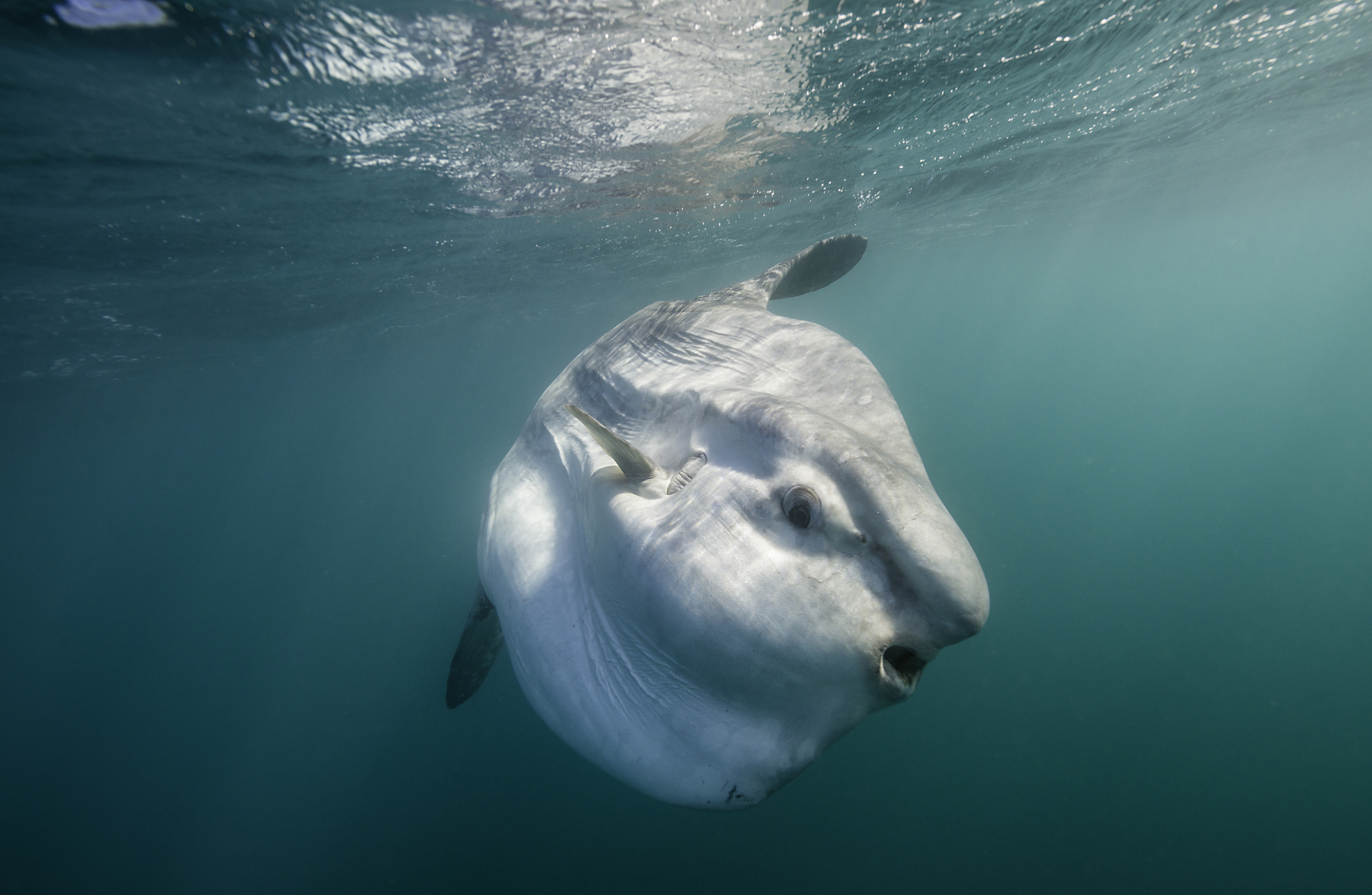
The sunfish is as pale as the moon and as round and flat as a dustbin lid, lying on its side as it basks in the sun. It may be warming up after a dive into deeper, colder waters, or it could be inviting birds to peck away parasites.
Nothing about the sunfish seems quite believable. Its body is like an old-fashioned doorknocker – circular, squat, with a fixed, openmouthed expression and a tall dorsal fin that cuts the water like a blade. This bizarre shape belongs to the second-largest bony fish on Earth, capable of exceeding 1,000kg and reaching beyond three metres in size.
Although the ocean sunfish’s tail is little more than a rippling, fan-like edge, it travels well, with slow and steady persistence. One tracked individual covered over 2,500km in just a few months.
Those sunfish reaching UK waters are usually on the smaller side, but equally strange looking – thin as though pressed flat. These summer visitors are primarily spotted off the south and west coasts of England, especially around Cornwall, with occasional sightings extending into the Irish Sea, Wales and western Scotland.
Prolific breeding
Sunfish don’t visit British waters to idle; they are drawn here to hunt prey, particularly the barrel jellyfish, a pale golden giant of the Irish Sea. Sunfish gather where jellyfish are abundant and can be seen drifting near the surface between feeding dives, their tall dorsal fins slicing through the water like slow-moving sails.
The sunfish’s throat is laced with hooked pharyngeal teeth, perfectly adapted to help it consume such slippery prey. Sadly, it may also eat stray plastic bags floating in the water. In terms of breeding, the sunfish is wildly prolific.
A single female may release up to 300 million eggs in one season – more than any other known vertebrate. Despite these vast numbers, survival is brutally low; only a tiny fraction will reach adulthood.
The young begin life as tiny, spined larvae, unlike the smooth giants they will become. Global population sizes remain unclear, as sunfish roam widely and are hard to count. However, they are classified as an internationally vulnerable species. Like dolphins, thousands of sunfish are caught each year as bycatch, particularly in drift nets and longlines. In UK waters, sightings have increased in recent years, likely reflecting both warming seas and improved reporting rather than a clear population boom.