
Around 3000 BCE, Otzi crossed the Alps wearing garments made from animal hides and braided grass, all dyed with natural pigments. The well-preserved Iceman, found in 1991 by two German tourists exploring the Tyrolean Alps between Italy and Austria, was ahead of his time, dressed in environmentally friendly performance wear.
Forward to 2026 and inevitably your mountain adventures are accompanied by PFAS (per- and polyfluoroalkyl substances) – a class of over 10,000 ‘forever chemicals’ that are commonly used in the manufacturing of active apparel. Likewise, synthetic fibres such as polyester, nylon and spandex might help your body breathe, add durability and increase a garment’s flexibility, but their inability to degrade can result in significant contamination of the environment.
PFAS are known to bioaccumulate in people, animals and plants, and have been linked to a range of health problems including testicular and kidney cancers, thyroid disease, ulcerative colitis, high cholesterol and pregnancy-induced hypertension.
Europe has banned some PFAS and the UK government released its PFAS plan in February 2026, intended to minimise the environmental and public health impact of these chemicals. It’s seemingly a bureaucratic step toward a PFAS-free planet. But does the world need to be sprinting instead? Here’s where Performance Without Toxicity comes in…
Sustainable start-ups
It’s a balmy Wednesday in London and I’m wandering the rejuvenated streets of King’s Cross. What was once an industrial wasteland has been transformed this century thanks to new streets, squares, parks and even a university. The heart of this urban regeneration is the uber-cool, canal-side Coal Drops Yard, brimming with youthful ambition, independent retailers and hip architecture.
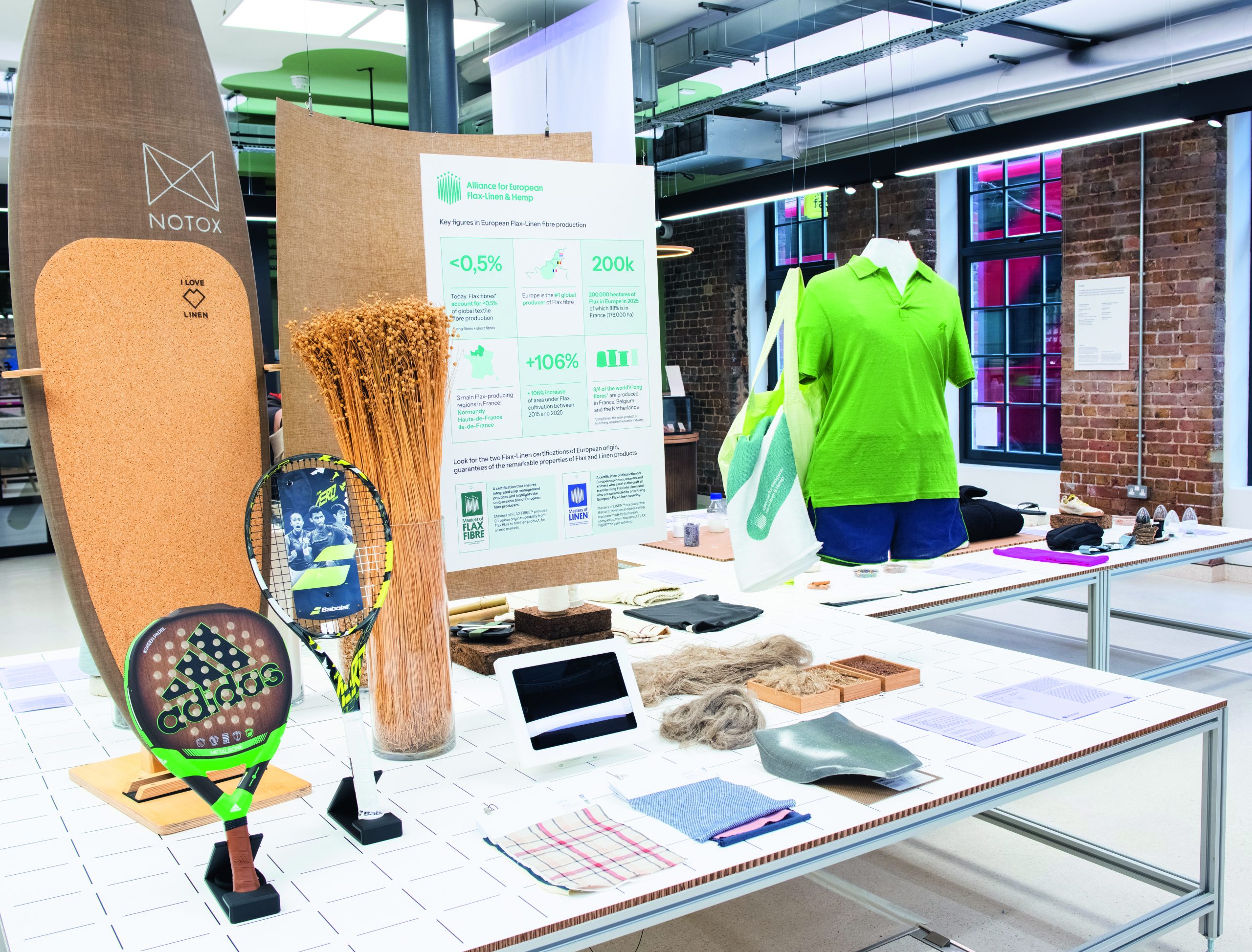
It’s Instagram-friendly. And environmentally friendly, too, as long-term sustainability was factored into the entire renaissance, from the reused heritage buildings to its green-roof strategy that encourages flora and fauna to flourish. It’s an apt backdrop to my nearby destination, the gallery and concept store Fabrica X and its latest exhibition, Performance Without Toxicity (open until 17 July).
Fabrica is the innovation arm of The Mills, a heritage revitalisation project that originated from the Nan Fung Group’s textile legacy in Hong Kong. “Our focus is to support and accelerate startups that are driving sustainable and social impact, primarily across textile and agri-food industries,” says curator Viktoria Espelund.
Performance Without Toxicity is their biggest exhibition to date, featuring 37 projects that showcase areas of apparel innovation, from new sweatwicking, odour-beating materials to waterproof coatings. To think about the circularity and durability of products. About creating garments with less waste. And footwear. “A single pair can contain more than 60 materials, joined with adhesives, stitching and moulding,” says Espelund. “How can you recycle a shoe when it has so many components?”
It’s why, of the 24 billion pairs of shoes manufactured annually, nearly 90% end up in landfills or incineration, trapping in combinations of EVA foam, polyurethane outsoles and textiles that resist breakdown and release microplastics into the environment. But what if you cut those components down to a handful and make it entirely biobased?
Cue B-Corp-rated footwear brand Allbirds, whose trainers comprise merino wool, tree fibre and SweetFoam, the world’s first sugarcane-based green EVA foam. These materials aim to offer functional benefits such as temperature regulation, breathability and odour resistance – qualities that synthetic fibres typically achieve only through intensive processing and the use of harsh chemicals.
Then there’s Uncrude plant-based soles from the Indian company A Blunt Story, which are free from crude-oil-derived plastics, resins and synthetic rubbers. The soles feature a 70% bio-based outsole and 94% bio-based midsole, eliminating microplastic shedding and reportedly reducing lifecycle emissions by more than 60%.
Carb clothing

I spot a pair of Merrell boots. Nothing transformative there. “But this model uses Solarcare insulation,” says Espelund. This is a NASA-developed aerogel-based barrier that retains heat without added weight or stiffness, supporting movement in cold, uneven terrain.
The design earned a global sports industry ISPO award for thermal efficiency, durability and lower-impact material use. Not bad for a material that’s 99.8% air. The hikers among you might wear Merrell or Keen. Perhaps your walks are fuelled by an energetic snack such as Kendal Mint Cake. Alternatively, you could wear your high-carbohydrate morsel. That’s the idea behind a San Francisco start-up.
“Most textiles rely on one of two extractive models: either pulling fossil fuels from the ground to make polyester or using large amounts of land and water to grow crops like cotton,” says Hitesh Manglani, CEO at Supercarb. “Today, roughly 80% of clothing is made from just two fibres: polyester (60%) and cotton (20%).
Both come with significant environmental trade-offs. Cotton is highly water- and chemical-intensive, while polyester isn’t biodegradable, carries a significant carbon footprint, and contributes to the growing problem of microplastic pollution in oceans and waterways." Manglani believes Supercarb offers a different model.
“By turning carbohydrate-rich waste streams into fibres, we avoid both fossil extraction and resource-intensive crop production. Upcycling waste biomass such as seaweed and citrus peels fundamentally changes how clothing is made today.” Supercarb fibres use about 38 times less water than cotton – roughly 261 litres per kilogram (L/kg) of fibre versus 10,000 L/kg – while they emit roughly half the carbon emissions of polyester, which should enable biodegradation at the product’s end of life.
Manglani also believes that durability, breathability and comfort aren’t compromised. The real problem, he says, is fiscal – specifically how margins are distributed from fibre to retail. “If you take Nike as an example, its historical net margins have ranged from roughly 5 to 14% and currently sit at about 5.43%. If margins are tight even for one of the world’s largest sportswear companies, that pressure inevitably reverberates across the entire supply chain.”
To preserve profit margins, Manglani believes that some brands often default to the cheapest scalable inputs, which usually means fossilbased synthetic fibres such as polyester. “This locks the industry into petrochemicals, microplastic shedding and high upstream emissions,” he adds. “But the problem doesn’t stop at raw materials.
Dyeing, finishing, coating and washing are often among the most resource-intensive stages because they consume large amounts of water, heat and chemicals. This is also where many performance properties are added through problematic chemistries, so the industry often solves for function in ways that create toxicity and end-of-life challenges.” To create a real shift in any industry with a new technology, two things must move together: supply and demand.
“In practical terms, Supercarb must prove that our technology can scale to millions of tonnes if it’s going to make a meaningful dent in an industry as large as textiles. At the same time, brands need to show genuine intent to adopt these materials. If we can scale alongside incumbent supply-chain partners, the shift from hydrocarbon-based textiles to carbohydrate-based ones becomes far more practical, faster and easier for brands to adopt at commercial volume.”
This would then lead to new markets opening for agricultural by-products. “The feedstocks that contain our target polymer in high yields include grape pomace, citrus peel, potato peel, apple pomace and sugar beet waste,” explains Manglani. Across these feedstocks, Supercarb estimates there are more than 300 billion kilograms of potentially usable residual biomass available, enough to displace roughly 7% of the global textile fibre market.
Today, however, most of these by-products are used in low-value applications such as animal feed. “This creates a real opportunity for rural communities. Instead of agricultural waste being treated as a disposal problem or sold into low-margin uses, it can become a higher-value industrial feedstock,” Manglani adds.
Peel, eat, recycle, hike. It’s the perfect ethos. As is weed to wear. That’s the idea behind London startup Tera Mira, who’ve developed a bio-based, seaweed-derived, non-toxic alternative to elastane. For the unfamiliar, elastane (also known as Lycra and spandex) is a stretchy material used in leggings and trousers. And then there’s PLNTMatter, whose patented pre-treatment formula, BIOnutrient, gently breaks down plant biomass, creating a cleaner, more cellulose-concentrated biomass.
Solving recycling

You might counter that it’s one thing creating materials that are friendly to both humans and nature, another managing years’ worth of synthetic fabric. It’s a fair point, of which Parisian company Syntetica might just have the solution.
“As soon as you have blends – multiple materials, multiple colours, finishing, dyes – it becomes really hard to recycle,” says founder Marco Bertone. “We’ve developed a depolymerisation process at low temperatures that enables us to selectively remove nylon from any other component to create 100% recycled nylon. That hasn’t been done in the industry before. And that’s why less than 1% of textile waste is recycled.”
Bertone says other eco-unfriendly fabrics are next on their radar: elastane, polyurethanes and polyesters. It’s a grand ambition but, of course, the ideal is that there’s less waste to begin with. That’s where Tokyo-based fashion laboratory Synflux comes in. “By using AI, they’re able to design garment patterns that cut down waste significantly,” explains Espelund. “It’s called ‘Algorithmic Couture’.”
The team at Japanese brand Goldwin, who helped organise the exhibition, have introduced this data-led technique to their paperpattern-cutting technology that converts 3D clothing surfaces into a matrix of triangles and squares, seen in front of me in the shape of a North Face jacket. (Goldwin owns many outdoor brands including North Face, Helly Hansen and Canterbury.) “They’ve eliminated football fields’ worth of fabric,” adds Espelund.
The ambition of Fabrica X and the brands who are seeking to balance human and environmental peak performance feels impressive. But are these eco-romantics grounded in reality? Opaque supply chains often mean that even manufacturers aren’t aware of everything that’s in their products, whether it’s dyeing and finishing to manufacturing the materials.
As Supercarb’s Manglani alluded to, suppliers will often be incentivised to do things as cheaply as possible. That often doesn’t align with pleasing the environment. Back to Espelund. “One of the big things we’ve tried to get across in this exhibition is ‘progress over perfection’. If we stop solutions because they’re imperfect, nothing will improve,” she adds.
“Apparel and footwear supply chains are deeply complex. For instance, new materials, new fibres, must fit on existing machinery. But start-ups are clever at navigating problems and finding solutions. These new options perform as well as synthetic fibres and are non-toxic. That’s something we need to celebrate. These gradual, incremental changes make a huge difference.”
