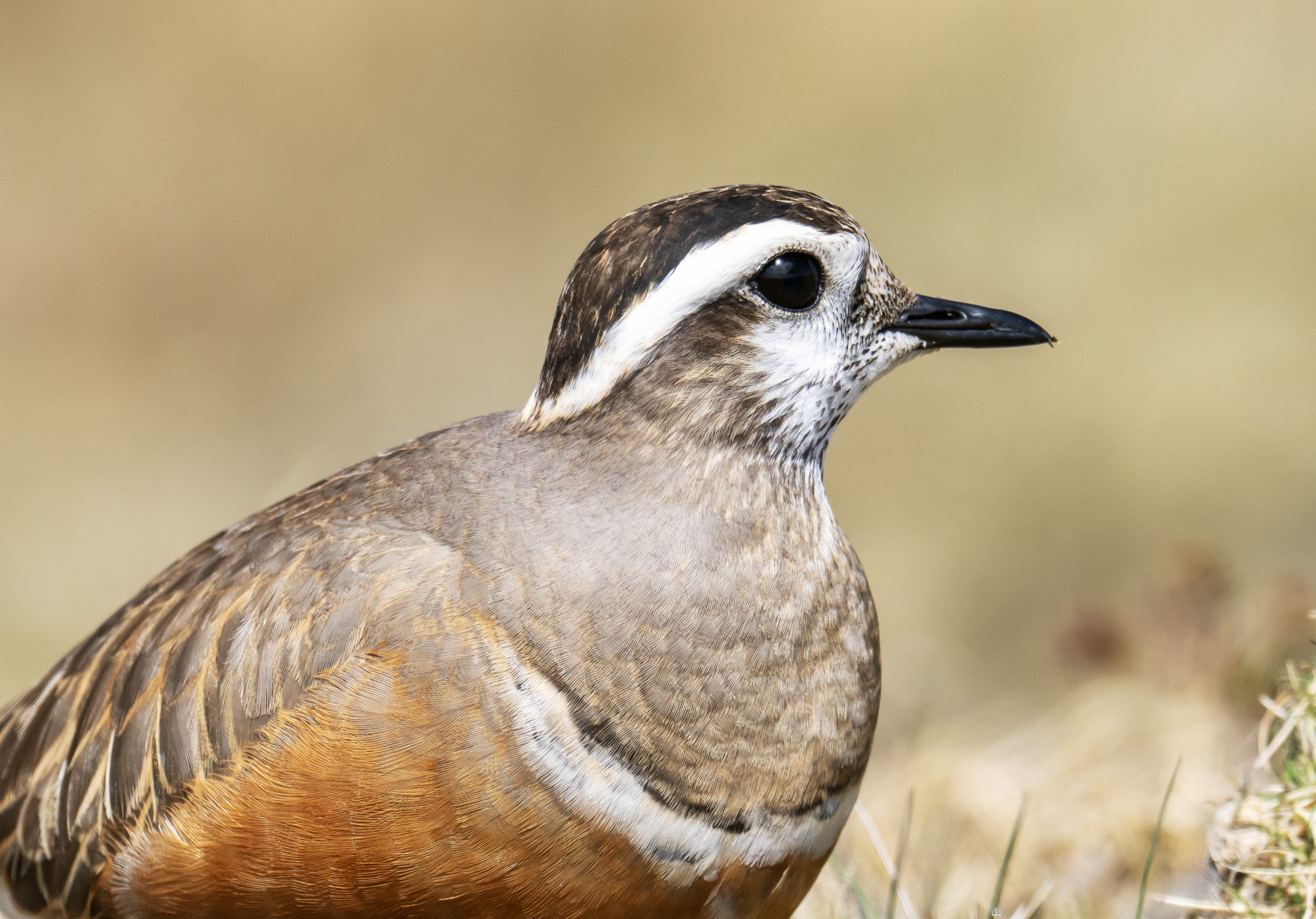
Sadly, I have never seen a dotterel and, for two good reasons, I never will. Scotland’s mountain tops, where these small wading birds in the plover family breed in summer, are beyond my reach these days – and their numbers are so perilously low they could be the UK’s first bird species to become extinct because of climate change.
Though the global population of dotterels in places like their North African wintering grounds is classed as ‘of least concern’, it’s a different story in the eastern and northern Highlands. An RSPB survey this year of 217 sites, including protected ones, revealed that only 33 breeding males had been detected.
None were spotted in England, Wales and southern Scotland and it’s estimated the national total is 112, a decline of 89% since the first survey in 1988. But why the emphasis on breeding males?
In a clear case of avian role reversal, the female dotterel – the more colourful in every way – lays her eggs and then abandons the nest in search of other partners, leaving the male to incubate them and raise the chicks.
With climate change affecting their food supply and habitats, the sharply declining male numbers put the survival of the species in real danger. High-mountain plateaus are especially vulnerable: hotter weather and less snow cover results in shrubs and grasses moving in from lower altitudes and smothering the low-growing alpine plants on which dotterels feed.
The larvae of one of their favourite prey, craneflies, are prone to drying out in the heat. Another serious threat comes from overgrazing by sheep and red deer on what is already sparse vegetation.
The birds are being forced to move higher up the mountains until they will eventually run out of space. The dotterel’s trusting behaviour also contributes to its plight. In the 15th century, the word dotterel meant both a person who is easily duped and a bird that is easily caught.
The human use of the word is now out of fashion, but it still holds true with the birds. Walkers and dogs can get very close to a male on nest duty, with all the dangers that entails. Dotterels are famed for their tameness but, with so many people hillwalking, there must be a limit to how much disturbance these fearless birds can withstand.
James Gordon, a research assistant on this year’s survey, saw his first dotterel nearly 40 years ago. “They are not fearless in the manner of urban crows or seagulls; theirs is more a ‘naïve’ fearlessness,” he tells me.
“When monitoring nests [under licence], one quickly discovers how varied are the responses. Some flutter off as soon as they detect an intruder, trusting – often correctly – that they will distract attention away from the nest. Others, trusting to camouflage, sit so tight that you can walk right up, crouch down and touch them before they move.”
How difficult is it to spot these idiosyncratic birds? “For a strikingly marked species, they can be remarkably elusive,” says James. “You hear a call, an insistent, repeated single note, half-muffled and displaced by wind or you notice one or more small heads protruding above a mossy hummock.”
It’s not only upland species such as the dotterel that face steep decline in numbers due to the changing climate: a new report from the RSPB and the British Trust for Ornithology warns that seabirds, including puffins and Arctic terns, are being impacted by warming seas, reduced food supplies and greater exposure to storms. Some seabird populations could decline by 80% by 2050.
“Climate change is already reshaping the UK’s birdlife, and the warning signs are impossible to ignore,” says Katie-Jo Luxton, the RSPB’s director of conservation.
“Nature is our life support system, and these birds are on the front line of climatic changes that affect us all. We must strengthen protections now and give nature the space it needs to adapt to support future generations of birds and people.”
As for dotterels, they have long trusted anyone who approaches them, even though in the past they were hunted and collectors stole their eggs. We must repay that trust: our warming planet continues to endanger them, so we need to control the level of grazing in their harsh, fragile habitats and leave in peace the few that remain.